
 +30 697.38.37.123
Info@SeaYou.gr
+30 697.38.37.123
Info@SeaYou.gr
There are moments at sea when the difference between a good decision and a bad one is measured not in miles, but in seconds.
I experienced one of those moments during a long delivery from Les Sables-d’Olonne, France, to Lavrio, Greece.
We were off the coast of Algeria.
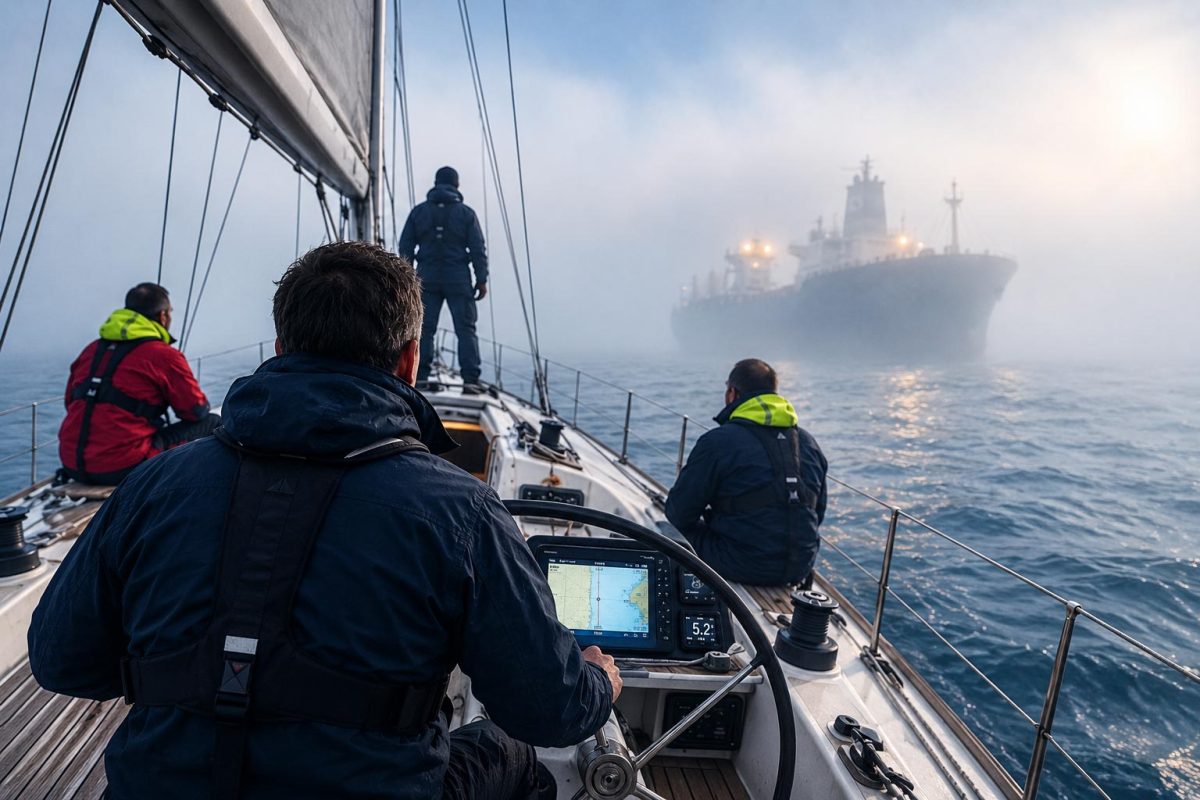
For almost three days and three nights, we were moving through dense fog.
Visibility would occasionally improve for a few brief moments. Those short windows of visibility felt almost like gifts.
The entire crew of four was on alert.
The captain was handling the VHF.
I was at the helm.
Two other crew members were positioned at different points on the boat, each watching the horizon for possible hazards that might not be visible from the helm.
Everyone was at their post.
There was very little room for distraction.
At some point, an instruction came from the leader boat:
“085° COG.”
I asked the captain to confirm:
“085° true course or COG?”
The answer I received was:
“True course.”
That was the beginning of the problem.
The original instruction had been 085° COG.
But the captain had interpreted it differently.
The critical part was that the instruction was not checked again with the leader boat.
Almost one to two hours later, we had gradually moved away from the intended track.
We were approximately three nautical miles away from the rest of the fleet.
In open water, three nautical miles might not immediately sound dramatic.
In dense fog, during a demanding offshore delivery, it is a completely different story.
But even that was not the real problem.
Before leaving France, I had spent a great deal of time thinking about communication and situational awareness.
On a delivery like this, communication is not a convenience.
It is part of the safety system.
One of the pieces of equipment I had specifically chosen to carry was a new handheld VHF with an integrated AIS receiver.
There was, however, a practical problem.
The boat did not have a 220V inverter, so I could not simply recharge the device whenever I wanted.
I had to manage its battery carefully.
That meant I could not leave it running continuously.
Instead, I switched it on periodically, at intervals I considered appropriate, specifically to maintain an additional layer of situational awareness.
On one of those checks, I discovered something important.
We were approximately three nautical miles away from the rest of the fleet.
And then the AIS showed something much more serious.
A 178-metre vessel was approaching.
The AIS was providing CPA and TCPA information.
I do not remember the exact values today, and I will not invent them.
But I remember the two numbers that mattered.
We were making 5.2 knots.
The other vessel was making 16.7 knots.
The vessels were only about 2.7 nautical miles apart.
The fog was still there.
Visibility was almost nonexistent.
And the AIS showed that we were on a collision course.
There was no luxury of time.
This was no longer a discussion about navigation theory.
It was a decision-making problem under pressure.
This is where the Captain’s Bubble became visible.
The captain did not make a decision.
I proposed a solution:
80° to starboard and increase speed to maximum RPM.
The reasoning was simple.
We needed to create separation from the approaching vessel while simultaneously positioning ourselves so that we could regain contact with the rest of the fleet.
The captain did nothing.
I was not alone in remaining alert. Angelos and I continued to monitor the situation.
The difficulty was not a lack of information.
We had the information.
The difficulty was converting that information into a mental picture of what would happen next.
This is something I have always been particularly conscious of.
Since I was a child, I have had an almost obsessive relationship with time and distance.
I used to create a kind of mental logbook.
On a bicycle.
Later in a car.
And eventually on boats.
I would mentally calculate how long it took to cover a certain distance, how speed changed the outcome, and where we would be after a given amount of time.
It became instinctive.
And in that fog, that instinct became useful.
Because when you have only 2.7 nautical miles, you cannot think only in terms of direction.
You have to think in terms of distance, speed, time and consequences.
The rest of the crew did not accept my proposal.
But they did not offer an alternative either.
And this is another important part of the story.
The problem was not that somebody disagreed with me.
Disagreement is healthy.
The problem was that we were facing a situation where a decision was required, yet the crew had not collectively managed to build a workable picture of what was happening.
At that point, I made a decision.
I contacted the leader boat.
I explained the situation.
I explained our position.
I explained the approaching vessel.
And I explained the manoeuvre I was proposing.
The response was immediate.
The leader understood the plan.
He agreed with it.
He told me it was the only realistic and safe solution that would allow us to deal with the approaching vessel while also giving us the possibility of reconnecting with the rest of the fleet.
We executed the manoeuvre.
Within the first minute, the AIS showed that the situation had changed.
The immediate collision threat had been avoided.
About an hour later, we met the rest of the fleet again.
Two problems had been solved with one decision.
But the most important outcome was not that I had proposed the correct manoeuvre.
The most important outcome was something else.
The crew had remained capable of contributing when the person in command could no longer provide the solution.
That distinction matters.
I have no interest in telling this story as:
“The captain was wrong and Antonis was right.”
I know what happened.
And that is enough for me.
The lesson is much bigger than that.
A skipper carries the responsibility for the vessel.
But that does not mean the skipper should be the only person capable of thinking.
In fact, on a demanding voyage, that can become dangerous.
The skipper needs a crew that can observe.
A crew that can calculate.
A crew that can question.
A crew that can communicate.
And, when necessary, a crew that can say:
“I think there is another option.”
Not because the crew wants to take command.
But because the crew wants to help the skipper make the best possible decision.
That is the opposite of the Captain’s Bubble.
After we had reunited with the fleet, there was no dramatic confrontation.
There was no discussion about who had been right or wrong.
The lesson that remained was much simpler.
We needed to be clearer with our instructions.
I remember saying that the solution was almost absurdly simple.
It was as simple as the distance between a finger and the PTT button.
It was just a PTT. Just a call.
One additional call to confirm the instruction could have prevented the entire chain of events.
From that point onward, the leader introduced a simple change.
It was no longer enough for each boat to respond:
“Received.”
The instruction had to be repeated back.
The message was sent.
The receiving boat acknowledged it.
The receiving boat repeated the instruction.
The sender could then confirm that the message had actually been understood.
A small change.
But a powerful one.
This is known as closed-loop communication.
And sometimes safety improvements are exactly that simple.
There is an important distinction here.
A crew that challenges the skipper is not a crew that undermines the skipper.
Quite the opposite.
A strong crew protects the skipper from the limitations that every human being has.
Limited attention.
Limited perception.
Limited information.
Limited time.
And, under pressure, limited cognitive capacity.
The purpose of teamwork is not to create five captains on one boat.
It is to create one decision-making system with more eyes, more information and more perspectives than any single person could have alone.
The skipper remains responsible.
But the crew becomes part of the safety architecture.
That is what good leadership at sea should look like.
This is why I do not see the Captain’s Bubble simply as an ego problem.
Sometimes it is.
But often it is much more subtle.
It can begin with experience.
With authority.
With trust.
With the assumption that the skipper knows what to do.
And then, when pressure increases, everyone unconsciously waits for the person in command to provide the answer.
The skipper looks at the crew.
The crew looks at the skipper.
And the clock keeps running.
That is the moment when the bubble becomes dangerous.
The solution is not to weaken the authority of the skipper.
The solution is to strengthen the capability of the crew.
Because the best skipper is not the person who always has the answer.
It is the person who has built a crew capable of helping find the answer when the situation becomes more complicated than any one person can process alone.
I remember those three days and nights in the fog very clearly.
Not because of the visibility.
Not because of the 178-metre vessel.
Not even because we were three nautical miles away from the rest of the fleet.
I remember them because they demonstrated something that cannot be learned entirely from a textbook.
Theory gives you tools.
Experience teaches you when to use them.
And good teamwork allows those tools to remain available when pressure starts affecting the person in command.
The sea does not care who has the highest qualification onboard.
It does not care who has the most miles.
It does not care who is officially responsible.
When the situation becomes critical, what matters is whether the people onboard can transform information into action.
That is seamanship.
And that is leadership.
The Captain’s Bubble is not something we should be ashamed of.
It is something we should learn to recognise.
Every skipper can become trapped inside it.
Especially when pressure increases.
Especially when everyone expects the skipper to have the answer.
The solution is not to have a crew that blindly follows.
And it is not to have a crew that constantly challenges authority for the sake of challenging it.
The solution is to have a crew that thinks with the skipper.
A crew that communicates clearly.
A crew that confirms instructions.
A crew that understands the bigger picture.
A crew that can say:
“I see something you may not be seeing.”
And a skipper who is confident enough to listen.
Because the best decisions at sea are rarely the product of one brilliant individual.
They are usually the result of several people seeing different pieces of the same picture — and having the discipline to put those pieces together before time runs out.
The real measure of a skipper is not whether they can make every decision alone.
It is whether they have built a crew capable of helping them make the right decision when it matters most.
A skipper should lead the decision.
But the crew should help build it.