
 +30 697.38.37.123
Info@SeaYou.gr
+30 697.38.37.123
Info@SeaYou.gr
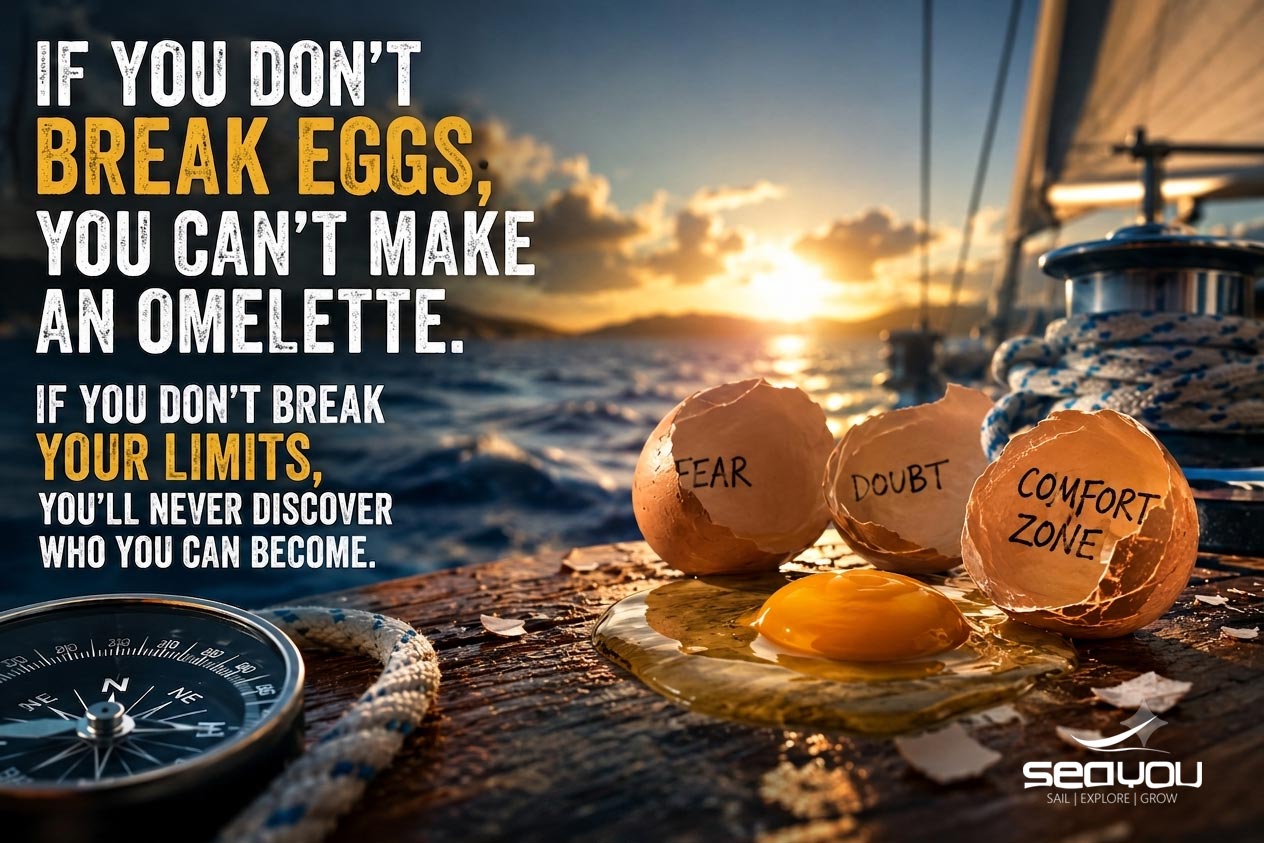
If You Don’t Break Eggs, You Can’t Make an Omelette. If You Don’t Break Your Limits, You’ll Never Discover Who You Can Become.
The sea was calm.
One of those rare afternoons when everything seems effortless.
The yacht moved gently across the water, the horizon stretched endlessly ahead, and the silence was broken only by the sound of the waves against the hull.
Next to me stood a student who had almost completed his sailing course.
He had practised the manoeuvres.
Handled the yacht with confidence.
Made good decisions.
Corrected his mistakes.
By every measurable standard, he had done well.
So I asked him one simple question.
“Do you think you’re ready?”
He smiled.
Without hesitation, he answered:
“Yes.”
I smiled back.
Then I replied:
“Good. Now your real education begins.”
For a moment, he looked confused.
Hadn’t he just completed the course?
Wasn’t that the finish line?
The answer is no.
Because education was never meant to end with a certificate.
A certificate simply tells the world that you’ve reached a certain standard.
It doesn’t mean you’ve reached your potential.
The greatest lessons don’t begin inside a classroom.
They begin the moment you realise how much more there is still to learn.
That realisation changed my own life many years ago.
And looking back, I now believe it has very little to do with sailing.
Or diving.
Or even the sea itself.
It has everything to do with the way we choose to live.
There is an old Greek proverb that almost everyone knows.
“If you don’t break eggs, you can’t make an omelette.”
Most people understand it as a reminder that every worthwhile achievement requires effort, sacrifice or difficult decisions.
They’re right.
But I also believe the proverb hides another lesson.
Perhaps the most important things we ever have to break aren’t objects at all.
Perhaps they are the invisible limits we’ve accepted without ever questioning them.
Fear.
Comfort.
Routine.
Pride.
The belief that we’re too old.
Too inexperienced.
Too late.
Or perhaps even more dangerous…
The belief that we already know enough.
Those are the real eggs.
And unless we’re willing to break them, nothing truly new can be created.
Very few people consciously decide to stop growing.
It happens gradually.
Almost unnoticed.
One day we stop asking questions.
Then we stop reading.
Then we stop seeking feedback.
Eventually we become experts only in repeating what we already know.
The strange thing is that these limits rarely come from other people.
We build them ourselves.
We say:
“I’m not ready.”
“I’m too busy.”
“Maybe next year.”
“Someone else can do that.”
The problem isn’t that these thoughts exist.
The problem is that, after hearing them often enough, we begin to believe them.
Over time they stop sounding like excuses.
They start sounding like facts.
And that’s when growth quietly comes to an end.
The most dangerous prison has no walls.
It’s built from assumptions we’ve never challenged.
If you’ve ever felt uncomfortable while learning something new, there’s nothing wrong with you.
Your brain is simply doing what it was designed to do.
It loves efficiency.
It loves certainty.
It loves familiar routines.
Every new skill requires energy.
Every unfamiliar situation creates uncertainty.
That’s why learning often feels uncomfortable before it feels rewarding.
Many people mistake this discomfort for failure.
It isn’t.
It’s evidence that your brain is adapting.
Growing.
Creating new pathways.
The challenge is learning to recognise the difference between discomfort and danger.
They’re not the same thing.
One should be embraced.
The other should be respected.
This distinction has shaped the way I teach every course, whether in sailing or scuba diving.
Students don’t become better because they’re pushed into dangerous situations.
They become better because they’re guided through carefully designed experiences that expand their abilities one step at a time.
That’s also the philosophy behind the SeaYou Mentorship System.
Education doesn’t end with a certification.
In many ways, that’s where the most meaningful part of the journey begins.
Through continuous coaching, practical experience and honest feedback, learning becomes a lifelong process—not a single event.
“The day you stop being a student is the day you stop becoming better.”
I have never believed that experience alone creates expertise.
Experience without reflection simply creates repetition.
Experience combined with curiosity creates wisdom.
And curiosity begins with one simple decision:
To admit that today’s version of yourself is not the final one.
There is a saying I have carried with me for years:
“Half-knowledge is worse than ignorance.”
The more time I spend teaching, the more convinced I become that this isn’t just a proverb—it’s a reality.
Someone who knows they don’t know will ask questions.
They will listen.
They will seek advice.
They will train.
But someone who believes they already know enough often stops learning altogether.
That is where progress slows.
And sometimes, that is where accidents begin.
Whether you’re sailing offshore, planning a dive, or leading a team, confidence without competence can be dangerous.
The sea has a remarkable way of exposing the gap between what we think we know and what we actually understand.
It doesn’t punish curiosity.
It punishes complacency.
Real confidence isn’t loud.
It doesn’t need to prove itself.
It comes from preparation.
From repetition.
From experience built on knowledge—not assumptions.
One of the greatest lessons I’ve learned is this:
The more you learn, the more you realise how much remains to be discovered.
That isn’t discouraging.
It’s liberating.
Because it keeps your mind open.
And an open mind is one of the most valuable safety tools you’ll ever carry.
There was a time when I believed experience alone would eventually make me an expert.
After all, I had spent countless hours at sea.
I had managed crews.
Handled difficult situations.
Made mistakes.
Solved problems.
Like many people working in the maritime industry, I believed that experience naturally led to mastery.
Until one day I realised something uncomfortable.
Experience answers many questions.
Education teaches you which questions you should have been asking in the first place.
That realisation changed the direction of my life.
Instead of assuming I knew enough, I became curious about everything I didn’t know.
I wanted to understand not only how things worked, but why they worked.
That curiosity led me to become a scuba diving instructor.
Later, it led me to qualify as an ISSA Sailing Instructor.
Many people assume becoming an instructor means you’ve reached the top.
I see it differently.
Becoming an instructor simply means you’ve accepted a greater responsibility to keep learning.
Because the moment your students stop challenging you…
You stop growing too.
Even today I continue reading.
Attending seminars.
Learning from instructors, captains, divers and professionals whose experience is different from my own.
Every conversation has the potential to teach something new.
Every mistake has the potential to become a lesson.
And every lesson reminds me that education has no finish line.
One of the most common pieces of advice in personal development is:
“Step outside your comfort zone.”
It’s good advice.
But it’s incomplete.
Many people assume growth requires taking unnecessary risks.
It doesn’t.
In fact, confusing growth with recklessness is one of the biggest mistakes anyone can make.
The best learning happens inside what educators often call the Learning Zone.
Not inside the Comfort Zone.
And certainly not inside the Danger Zone.
Inside the Learning Zone you feel challenged.
You feel slightly uncomfortable.
You make mistakes.
But you make them in an environment where they’re expected, analysed and transformed into experience.
That’s exactly how I believe sailing and diving should be taught.
Not through fear.
Not through unnecessary pressure.
But through carefully increasing responsibility.
Every lesson should stretch your abilities just beyond yesterday’s limits.
Not beyond your capacity.
That’s how confidence grows.
Not because someone told you to believe in yourself.
But because you’ve earned the right to believe in your abilities.
That philosophy is at the heart of every programme we develop.
The SeaYou Mentorship System extends this approach beyond the classroom, allowing students to continue building experience through guidance, practical coaching and continuous development long after the course has finished.
People often ask me what the sea has taught me.
Most expect technical answers.
Navigation.
Weather.
Safety.
Boat handling.
Those lessons matter.
But they aren’t the most valuable ones.
The sea has taught me about people.
I’ve watched complete beginners become exceptional sailors because they never stopped asking questions.
I’ve watched experienced skippers plateau because they believed they had nothing left to learn.
I’ve seen divers with very few logged dives display remarkable humility.
I’ve also seen highly experienced professionals make avoidable mistakes simply because routine had replaced awareness.
The sea doesn’t care about titles.
It doesn’t care how expensive your boat is.
Or how many certificates hang on your office wall.
The sea responds to preparation.
Judgement.
Respect.
Humility.
These qualities can’t be bought.
They can’t be downloaded.
And they certainly can’t be learned in a weekend.
They are built over years of deliberate practice.
One decision at a time.
One lesson at a time.
One honest reflection at a time.
That is why seamanship has never been just about boats.
Just as diving has never been just about breathing underwater.
Both are exercises in character.
People sometimes ask me why I created the SeaYou Mentorship System.
The answer is simple.
Because I realised something that many people discover only after years at sea:
Courses create certificates. Mentorship creates people.
A course has a beginning and an end.
A mentorship has milestones, but never a finish line.
A course teaches knowledge.
Mentorship develops judgement.
A course helps you pass an assessment.
Mentorship helps you make the right decision when nobody is there to assess you.
That difference matters.
Especially at sea.
Because the sea never asks where you trained.
It only asks one question:
“Are you prepared?”
Throughout my career, I’ve met people who collected certificates but never developed confidence.
I’ve also met people with relatively few qualifications who had built exceptional judgement because they never stopped learning.
That’s why I wanted SeaYou to become more than another training provider.
I wanted it to become a learning community.
A place where education doesn’t stop on the day you receive a certificate.
Where students remain connected.
Where questions are encouraged.
Where mistakes become lessons.
Where experience is shared instead of hidden.
Because the best instructors never create followers.
They create independent thinkers.
If the SeaYou Mentorship System succeeds in doing just one thing, I hope it is this:
To help people become safer, more capable and more responsible on the water—not only during a course, but throughout their entire journey.
When people hear the phrase “break your limits,” they often misunderstand it.
It does not mean breaking rules.
Rules exist for a reason.
Every maritime procedure…
Every diving protocol…
Every safety checklist…
Every briefing…
Has usually been written because someone, somewhere, paid the price for not having it.
Good judgement begins with respecting proven principles.
So if we shouldn’t break the rules…
What should we break?
Break the belief that you already know enough.
Break the habit of avoiding difficult conversations.
Break the comfort of doing things the way you’ve always done them.
Break the fear of asking questions.
Break the idea that making mistakes means you’ve failed.
Because mistakes don’t define us.
Refusing to learn from them does.
Every meaningful achievement begins with humility.
Humility creates curiosity.
Curiosity leads to learning.
Learning builds competence.
Competence creates confidence.
And confidence, when balanced by humility, becomes wisdom.
Perhaps that is the real journey.
People often describe SeaYou as a sailing school.
Or a diving academy.
Or a training company.
I understand why.
Training is what we do.
But it isn’t why we exist.
SeaYou was never built simply to teach people how to sail.
Or how to dive.
It was built to help people become better decision-makers.
Better teammates.
Better leaders.
Better human beings on the water.
Because technical skills can be taught.
Character is developed.
One decision at a time.
One challenge at a time.
One lesson at a time.
Every course we deliver shares the same purpose.
Not to create perfect skippers.
Not to create perfect divers.
But to create people who remain students for life.
Because those are the people who continue improving long after the course has finished.
And in my experience…
Those are also the people who inspire others to do the same.
Before you close this page, I’d like to ask you one question.
Not about sailing.
Not about diving.
Not even about the sea.
About you.
What is the one limit you’ve protected for years because you were afraid to break it?
Perhaps it’s the fear of failure.
Perhaps it’s the belief that you’re too old.
Too inexperienced.
Too busy.
Or simply that you’ve missed your opportunity.
Whatever it is…
Remember this.
The strongest shells are often the hardest to break.
But nothing new is ever born without leaving one behind.
Years ago, I believed that success meant knowing more.
Today, I believe success means never losing the desire to learn.
The best divers are not those with the most logged dives.
The best skippers are not always those with the most sea miles.
The best professionals are not the ones who have all the answers.
They are the ones who continue asking better questions.
Every single day.
If that means challenging another assumption…
Learning another skill…
Listening instead of speaking…
Admitting that I still have more to learn…
Then I’m exactly where I want to be.
Because, in the end, it isn’t really the eggs we’re afraid of breaking.
It’s the life waiting on the other side.
Never stop being a student.
The day you stop learning is the day you stop growing.