
 +30 697.38.37.123
Info@SeaYou.gr
+30 697.38.37.123
Info@SeaYou.gr
Safety, Risk Assessment & Accident Prevention
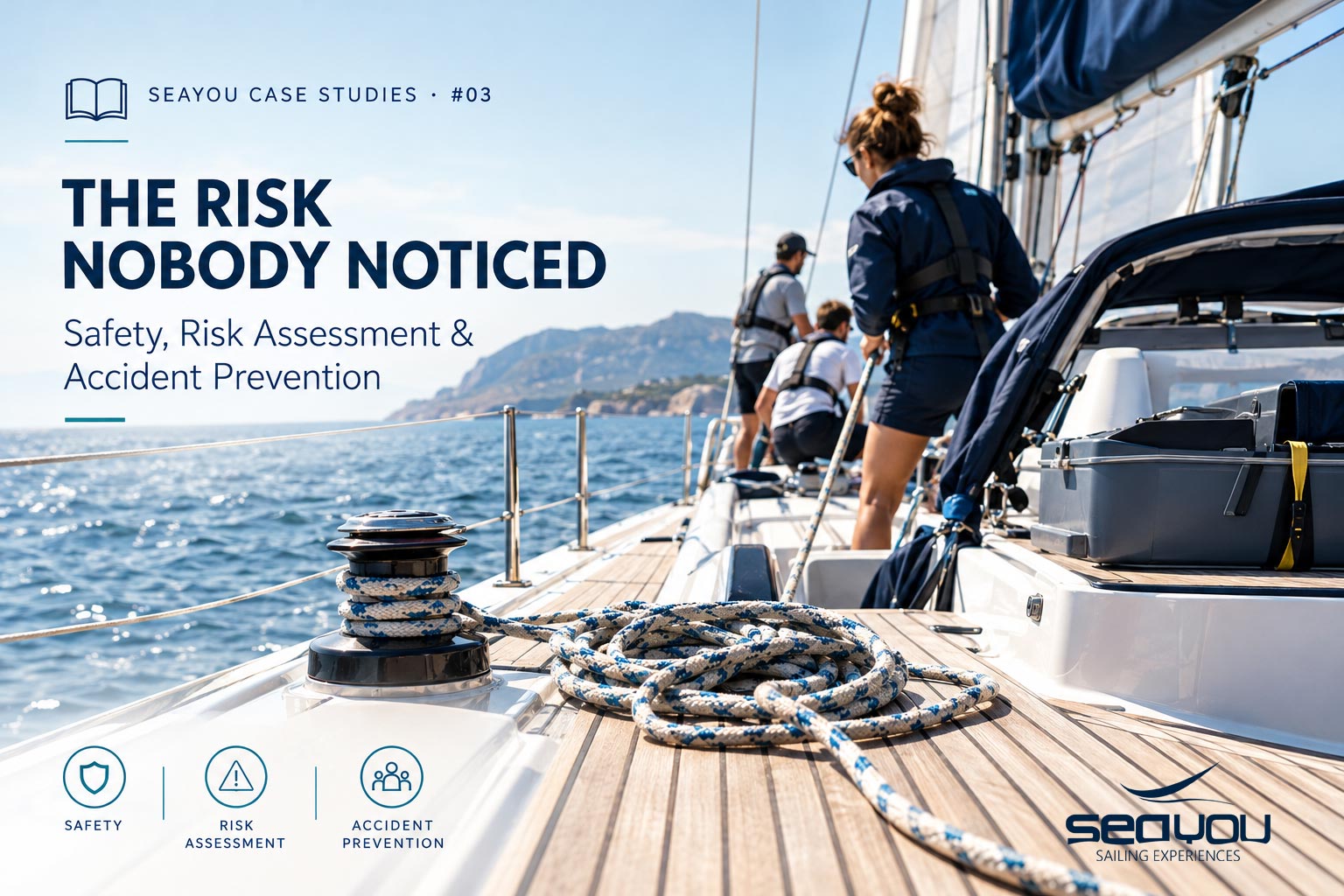
A sailing yacht is participating in an educational sailing flotilla.
The skipper and six trainees have been sailing together for several days. The weather is manageable, the yacht is performing normally, and the crew is becoming familiar with its routines.
Nothing appears to be wrong.
There is no emergency, no equipment failure, and no immediate threat. The next activity is a planned sail change, a familiar manoeuvre that the crew expects to complete without difficulty.
Yet several small details have developed during the morning.
A loose line remains near a frequently used passageway in the cockpit. Some equipment has been placed temporarily where crew members need to move during routine sailing activities. One trainee is preparing to go forward to assist with the sail change, while another is about to cross the cockpit to collect the required equipment.
None of these conditions has caused a problem so far.
The crew has worked around similar situations before. The line can be moved later. The equipment is only there temporarily. Everyone knows what they are supposed to do during the manoeuvre.
Individually, each issue appears manageable.
But the situation is about to change.
As the yacht prepares for the sail change, several crew members will need to move, handle equipment, communicate, and coordinate their actions within a relatively short period.
The conditions that seemed unimportant during routine sailing may now interact in ways that have not been considered.
The skipper is focused on preparing the manoeuvre. The trainees are thinking about their assigned tasks. No one has deliberately ignored safety, and no one has identified a single issue as serious enough to stop the activity.
The equipment needed for normal operations is available. The crew has already received a safety briefing.
But has anyone assessed the actual conditions that exist right now?
Before the sail change begins, the instructor pauses the scenario.
No one has fallen. No one has been injured. Nothing has been damaged.
The crew is asked to assess the situation as it stands, rather than assume that the planned manoeuvre should proceed simply because it is familiar.
What appears safe during one phase of sailing may not remain equally safe when the demands on the crew change.
A line near a passageway is one condition. Equipment obstructing movement is another. A crew member moving forward is a third. The upcoming manoeuvre adds another layer of activity.
The important question is not whether any single detail guarantees an accident. It does not.
The question is whether the combined conditions create a level of risk that deserves attention before the crew proceeds.
A hazard is something with the potential to cause harm.
Risk assessment goes further. It considers how harm could occur, how likely that outcome may be in the circumstances, and how serious the consequences could be.
A hazard may exist without an accident occurring. An accident may also be possible without being likely. Equally, an event that appears unlikely may still deserve serious consideration if its consequences could be severe.
This distinction matters because simply identifying hazards does not automatically tell a crew what to do first.
The trainees must consider the circumstances surrounding each hazard:
Who will be exposed?
What will those people be doing?
How might movement, equipment, and timing interact?
What could happen if one part of the operation does not go as expected?
How severe could the consequences be?
What can be changed before the activity begins?
There is no need to predict that an accident will happen. The purpose is to understand what could happen and decide whether the existing conditions are acceptable.
Risk is not always static.
A condition that presents limited difficulty during routine sailing may become more significant when several people must move around the same space, attention is divided, or equipment is being handled.
The environment has not necessarily become more dangerous in itself. The demands placed on the crew have changed.
This is one reason why safety checks should not be treated as a single event completed at the beginning of the day.
Conditions evolve. Tasks change. People become tired, distracted, or overconfident. Equipment is moved. Familiar routines can create an expectation that the next repetition will be just as straightforward as the previous one.
A useful assessment therefore considers not only what is happening now, but also what is about to happen.
Once the trainees have identified the hazards, they must consider what could be done before the sail change begins.
Would moving the loose line make a meaningful difference? Should the equipment be relocated? Does the crew need to clarify who will move where and when? Is the team ready to carry out the manoeuvre safely under the current conditions?
These questions are not necessarily answered by adding more equipment or repeating the original safety briefing.
Sometimes prevention means removing a hazard. Sometimes it means changing the sequence of a task, improving communication, allocating responsibilities, or delaying an activity until a safer working environment can be established.
The effectiveness of a measure matters more than the appearance of action.
A quick instruction is not enough if the underlying hazard remains. A tidy cockpit is not proof that every risk has been controlled. A completed checklist is useful only when it reflects the actual situation.
The crew must be able to explain what has changed and why that change reduces the risk.
Experience is valuable, but familiarity can influence how people perceive risk.
When a practice has been repeated many times without an incident, the absence of previous harm may begin to feel like evidence that the practice is safe.
It is not.
The fact that a loose line has never caused a fall does not establish that it cannot contribute to one. The fact that a crew has completed the same manoeuvre successfully does not mean that every repetition presents the same conditions.
At the same time, the presence of a hazard does not mean that an accident is inevitable.
Good seamanship requires neither complacency nor exaggerated fear. It requires a realistic assessment of the circumstances, the possible consequences, and the measures available to reduce exposure to harm.
The objective is not to eliminate every imaginable uncertainty. It is to identify meaningful risks and manage them in a deliberate, proportionate way.
The sail change has not yet begun.
The yacht is still sailing. The crew has time to observe, discuss, and make adjustments before committing to the next activity.
The trainees now have to decide how they would assess the situation and what they would recommend.
They should be prepared to explain their reasoning, not merely list hazards or offer a general statement that safety comes first.
Which conditions deserve immediate attention? Which combinations create the greatest concern? What additional information would help them assess the situation? Which preventive measures would make a meaningful difference? How would they confirm that those measures had worked?
There may be several defensible approaches, depending on the details and the assumptions made. The quality of each approach depends on how well the trainees identify the hazards, assess the risk, justify their priorities, and verify the effectiveness of their actions.
No accident has occurred.
That is precisely why this moment matters.
Safety is not measured only by how a crew responds when something goes wrong. It is also reflected in the conditions the crew notices, the risks it takes seriously, and the problems it addresses before anyone is harmed.
The challenge is to recognise when individually manageable details combine to create a situation that deserves a different level of attention.
If you were part of this crew, what would you address before the sail change began — and how would you know that your actions had genuinely made the operation safer?
SeaYou Case Studies — Educational Sailing Flotilla
This fictional scenario is designed for discussion and critical thinking. It is not a report of an actual maritime incident or a substitute for vessel-specific procedures, professional instruction, or applicable safety requirements.