GPS Is Not Seamanship: Why Navigation Technology Can Never Replace a Competent Skipper
Modern boating has never been easier.
With a smartphone, a chartplotter, and a GPS receiver, almost anyone can navigate a yacht from one destination to another with remarkable accuracy. Today’s marine electronics provide real-time positioning, weather forecasts, AIS traffic monitoring, depth information, and route planning that previous generations of sailors could only dream about.
Yet despite this technological revolution, maritime incidents continue to occur every year.
Groundings, collisions, navigational errors, and weather-related emergencies are not disappearing. In many cases, they are happening to skippers equipped with more technology than ever before.
The reason is simple:
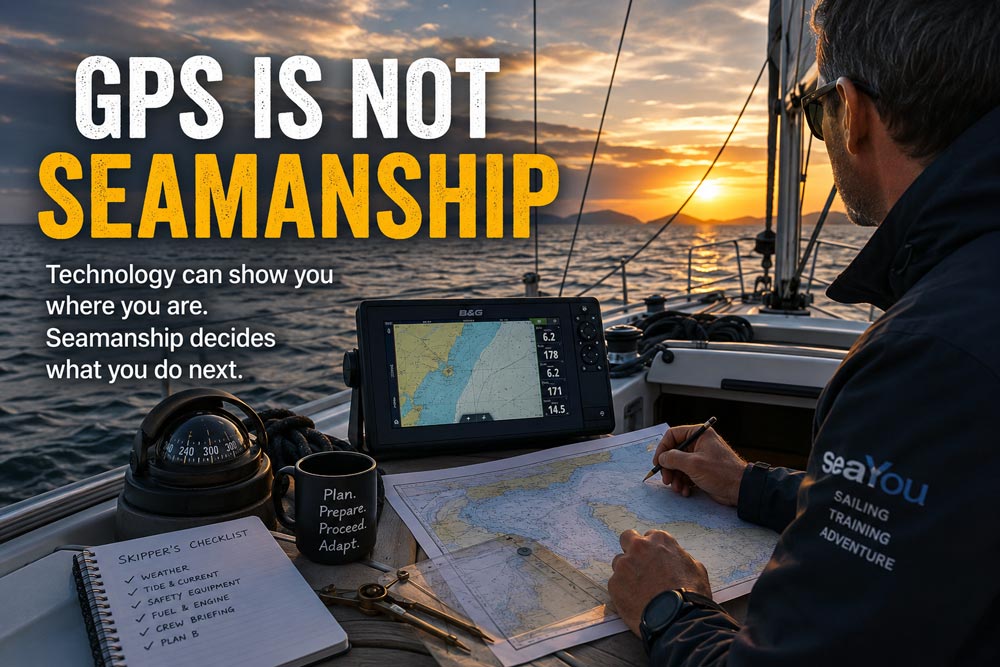
GPS is a navigation tool. Seamanship is a decision-making skill.
And confusing the two can be dangerous.
The Illusion of Safety Created by Technology
Technology creates a sense of certainty.
When a chartplotter shows your exact position within a few meters, it’s easy to believe that you are fully aware of your surroundings.
But navigation has never been only about knowing where you are.
True seamanship requires understanding:
- Where you are
- Where you are going
- What hazards exist around you
- How weather may affect your route
- How your vessel behaves under changing conditions
- What to do when things don’t go according to plan
A GPS can display data.
A skipper must interpret reality.
This distinction becomes critical when technology fails—or when the information displayed is incomplete.
The Most Dangerous Sentence at Sea
Many maritime accidents begin with a simple statement:
“The GPS says we’re fine.”
The GPS does not know:
- The skill level of your crew
- The reliability of your engine
- The sea state around a headland
- The sudden squall approaching from behind a mountain
- The fishing net that was deployed this morning
- The poorly maintained buoy that is no longer in position
Technology provides information.
Seamanship provides judgment.
When skippers begin to trust the screen more than their own observations, situational awareness starts to decline.
Electronic Navigation Has Made Some Skippers Worse
This may sound controversial, but many instructors have observed a growing dependence on electronic navigation systems.
Years ago, sailors routinely developed skills such as:
- Dead reckoning
- Visual navigation
- Position fixing
- Compass bearings
- Pilotage
- Tide and current assessment
Today, many recreational boaters simply follow a magenta line on a chartplotter.
The result is a phenomenon known as automation dependency.
The more we rely on technology, the less capable we become when technology is unavailable.
The aviation industry has studied this problem extensively, and the same lessons apply at sea.
When GPS Fails
Although GPS is extremely reliable, it is not infallible.
Possible failures include:
Signal Loss
High cliffs, electrical interference, equipment malfunction, or satellite issues can affect positioning accuracy.
Power Failure
A dead battery can instantly disable:
- Chartplotter
- GPS receiver
- Radar
- AIS
- Autopilot
Incorrect Data
Electronic charts may contain inaccuracies, outdated information, or missing local hazards.
Human Error
Perhaps the most common cause of navigation incidents.
Incorrect waypoints, wrong routes, improper chart settings, and overreliance on zoomed-in displays can all create dangerous situations.
In almost every case, good seamanship remains the final safety barrier.
What Real Seamanship Looks Like
A competent skipper constantly builds a mental picture of the environment.
Even while using advanced electronics, they continue to observe:
Weather Changes
Cloud formations.
Wind shifts.
Visibility changes.
Sea state development.
Traffic Awareness
Commercial vessels.
Fishing boats.
Swimmers.
Divers.
Small craft.
Local Hazards
Shallow water.
Rocks.
Sandbars.
Fishing gear.
Unmarked obstacles.
Escape Options
What happens if the engine stops?
Where is the nearest safe anchorage?
What is the alternative route?
Technology assists this process.
It does not replace it.
The Difference Between Navigation and Seamanship
Navigation answers one question:
“Where am I?”
Seamanship answers several more:
- What should I do next?
- Is this route still safe?
- How will conditions evolve?
- What are my alternatives?
- What risks am I accepting?
Many accidents occur not because the skipper became lost, but because they made poor decisions while knowing exactly where they were.
Good Skippers Always Have a Backup
Professional mariners rarely rely on a single source of information.
Instead, they cross-check.
A good skipper compares:
- GPS position
- Visual landmarks
- Depth readings
- Compass headings
- Weather observations
- Local knowledge
This layered approach reduces the risk of a single failure becoming a serious incident.
In safety management, this is known as avoiding a Single Point of Failure (SPOF).
If you enjoyed this topic, you may also read our article:
The Human Single Point of Failure on Pleasure Crafts
Because technology can become a SPOF just as easily as a person.
Seamanship Is a Mindset
The best skippers are not the ones with the most expensive electronics.
They are the ones who remain curious, observant, and prepared.
They continuously ask:
- What am I missing?
- What could change?
- What if this equipment stops working?
- What is my backup plan?
Technology rewards convenience.
Seamanship rewards preparation.
The sea does not care how advanced your chartplotter is.
It only responds to your decisions.
How to Develop Better Seamanship Skills
The good news is that seamanship can be learned.
Some of the most effective ways include:
Formal Training
Professional skipper training provides structured learning and practical experience.
Sailing in Different Conditions
Experience gained in varying weather conditions develops confidence and judgment.
Practicing Traditional Navigation
Even basic compass work and visual navigation improve situational awareness.
Learning from Experienced Mariners
Real-world stories often contain lessons no textbook can teach.
Regular Scenario Training
Ask yourself:
- What if the engine fails now?
- What if visibility drops suddenly?
- What if GPS becomes unavailable?
Mental rehearsal improves decision-making under pressure.
Conclusion
GPS is one of the greatest innovations in maritime history.
It has made boating safer, easier, and more accessible than ever before.
But GPS is not seamanship.
Technology can tell you where you are.
Only seamanship can help you decide what to do next.
The most capable skippers embrace technology without becoming dependent on it.
Because when conditions deteriorate, electronics become a tool.
Seamanship becomes the solution.