
 +30 697.38.37.123
Info@SeaYou.gr
+30 697.38.37.123
Info@SeaYou.gr
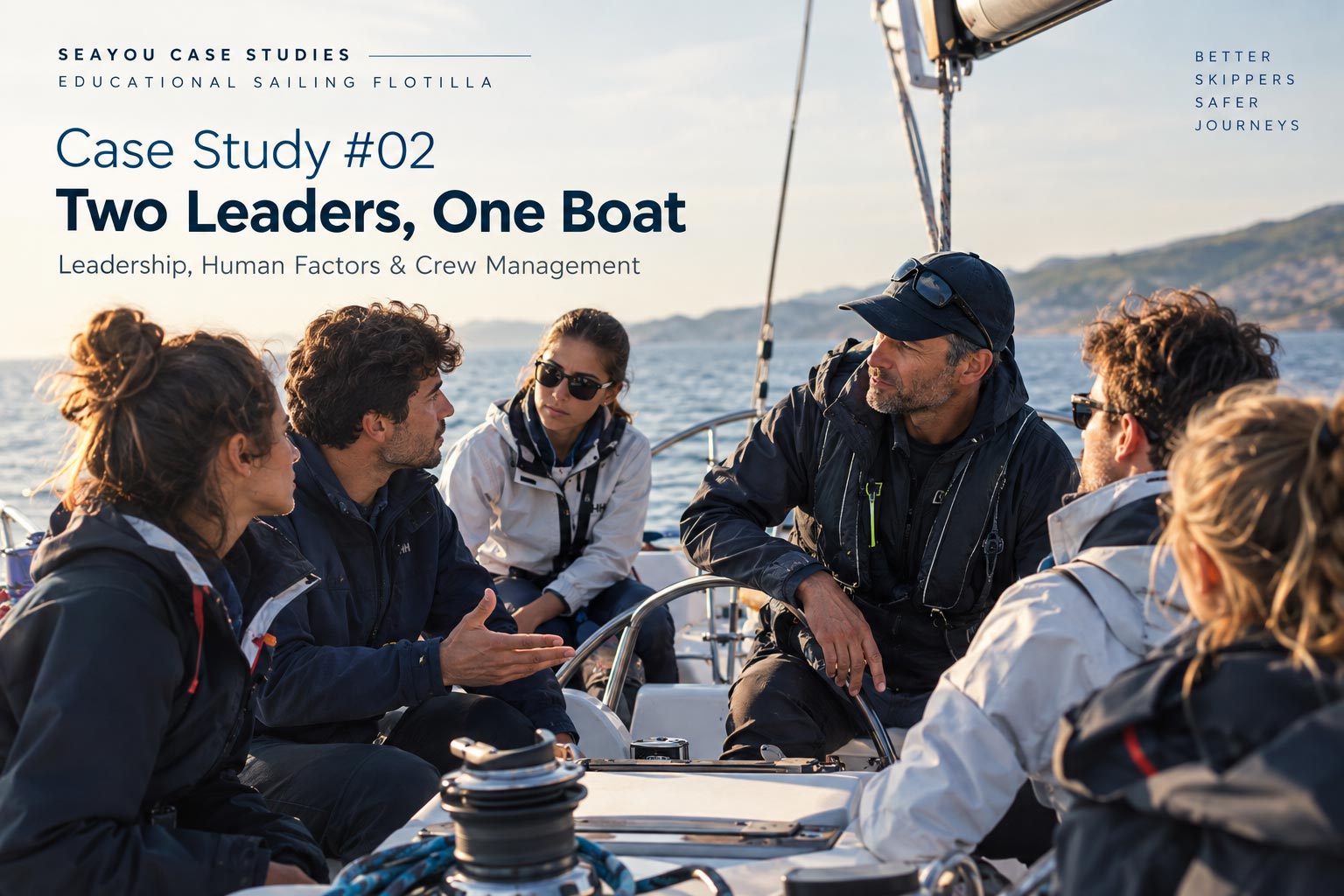
Case Study #02: Two Leaders, One Boat
An educational scenario about initiative, authority, teamwork and the challenge of leading people who have different ideas about how a boat should be run.
Scenario status: Fictional case study created for educational discussion. It is not a report of a real incident.
Six students are taking part in an educational sailing flotilla. They have spent several days aboard the same yacht, learning practical sailing skills, sharing responsibilities and adapting to life in a confined environment.
The conditions are manageable. There is no emergency, no immediate threat and no difficult weather decision to make.
Yet something is beginning to affect the crew.
Two students have developed noticeably different approaches to working on board.
Alex has more practical sailing experience. He is observant, confident and quick to recognise what needs to be done. When a task is approaching, he often prepares equipment, anticipates the next step and starts organising other crew members before the skipper has finished explaining the plan.
His intention is to help. He believes that a capable crew should be proactive rather than wait for every instruction.
Daniel has a different approach. He prefers a clear briefing, agreed roles and a shared understanding of who is responsible for each task. He believes that even an experienced crew member can create confusion by acting before the rest of the team is ready.
His intention is also to help. He believes that good seamanship requires coordination, not just individual competence.
Neither student is careless. Neither is deliberately trying to challenge the skipper’s authority.
Their methods, however, are beginning to conflict.
The yacht is preparing for a routine berthing manoeuvre.
The skipper is explaining the plan and assigning responsibilities. Before the briefing is complete, Alex begins preparing a line and tells another student where to position themselves.
Daniel interrupts.
“We haven’t finished the briefing yet. Let’s make sure everyone knows the plan first.”
Alex responds calmly, but with visible frustration.
“We know what needs to be done. I’m just getting things ready. We lose time when we wait for every little instruction.”
Daniel replies:
“And we create confusion when two people start giving instructions.”
The exchange is brief. No one raises their voice significantly. No one openly refuses an instruction.
But the atmosphere changes.
One student looks towards the skipper, waiting for a response. Another continues preparing the equipment without commenting. Two others exchange a glance but remain silent.
The skipper now has a choice to make.
The immediate task still needs to be completed. The crew also needs to understand how it will work together from this point onwards.
The manoeuvre is completed without damage or injury.
The practical outcome is satisfactory. The underlying disagreement is not resolved.
Alex believes that experience should allow a sailor to anticipate needs and take initiative. To him, excessive dependence on instructions can make a crew slow and ineffective.
Daniel believes that individual initiative must operate within an agreed plan. To him, even a technically competent sailor can introduce unnecessary risk when others do not know what is happening or who is directing the task.
Both perspectives contain reasonable arguments.
Initiative can improve efficiency, reveal problems early and reduce the skipper’s workload. But uncoordinated initiative can also lead to duplicated actions, conflicting instructions and uncertainty about responsibilities.
Procedures and briefings can create clarity, consistency and shared expectations. But excessive dependence on instructions can discourage people from speaking up, thinking independently or responding to an unexpected development.
The issue is not simply whether initiative or procedure is better.
It is how the crew combines them.
The disagreement is no longer limited to Alex and Daniel.
The other four students are watching how the situation develops.
One appreciates Alex’s confidence and practical ability. Another feels more comfortable when Daniel insists on clear roles. A third does not want to become involved in a disagreement between fellow students. The fourth is unsure whether the skipper expects students to take initiative or to wait for instructions.
None of them has openly challenged either student.
Their silence, however, does not necessarily mean agreement.
The group may be developing informal alliances. Some students may begin following Alex because they find him effective. Others may look to Daniel because his approach feels more structured. Some may simply stop contributing in order to avoid criticism.
The skipper’s next action could influence more than the relationship between two students. It could shape the behaviour of the entire crew.
Should the skipper intervene immediately and clarify who gives instructions during a manoeuvre?
Should the skipper speak to Alex and Daniel privately, allowing each to explain their perspective before addressing the crew?
Should the skipper use the situation as a learning opportunity and invite all six students to discuss how they want to organise teamwork on board?
Or should the skipper allow the students some space to resolve the disagreement themselves, intervening only if it begins to affect the task or the safe operation of the yacht?
Each option has potential benefits and limitations.
An immediate intervention may restore clarity, but it may also be interpreted as taking sides.
A private conversation may reduce defensiveness, but it will not automatically correct confusion affecting the whole crew.
A group discussion may create shared expectations, but it could become unproductive if students feel pressured to defend their friends or justify their own behaviour.
Allowing the disagreement to develop may encourage maturity and ownership, but it could also allow resentment and competing informal leadership to become established.
There is no single response that can be evaluated without considering timing, context, the crew’s experience and the skipper’s responsibilities.
One principle, however, remains important: listening to the crew does not remove the skipper’s responsibility to establish clear expectations and maintain safe, coordinated operations.
The next sailing day will bring another set of tasks, briefings and opportunities to work together.
The skipper cannot simply assume that the disagreement has disappeared because the previous manoeuvre was completed successfully.
Nor should the skipper automatically conclude that one student must be right and the other wrong.
The challenge is to create a working environment where initiative is welcomed, instructions remain clear, disagreements can be expressed constructively and every crew member understands their role.
If you were the skipper, what would you do next — and why?
Would you address the behaviour, redefine the roles, change the briefing process, involve the entire crew or take another approach?
More importantly, how would you know whether your response had worked?
There is no need to agree on one universal answer. The purpose of this case study is to examine the reasoning behind each option, the consequences it may create and the information the skipper would need before choosing a course of action.
Because on a sailing yacht, leadership is not measured only by how well a manoeuvre is completed.
It is also revealed in how people communicate, how responsibility is shared and how a crew learns to work together.
SeaYou Case Studies — Educational Sailing Flotilla
Better seamanship begins with better questions.