This post is also available in:
 Ελληνικα


This post is also available in:
Ελληνικα
If You Don’t Break Eggs, You Can’t Make an Omelette. If You Don’t Break Your Limits, You’ll Never Discover Who You Can Become.
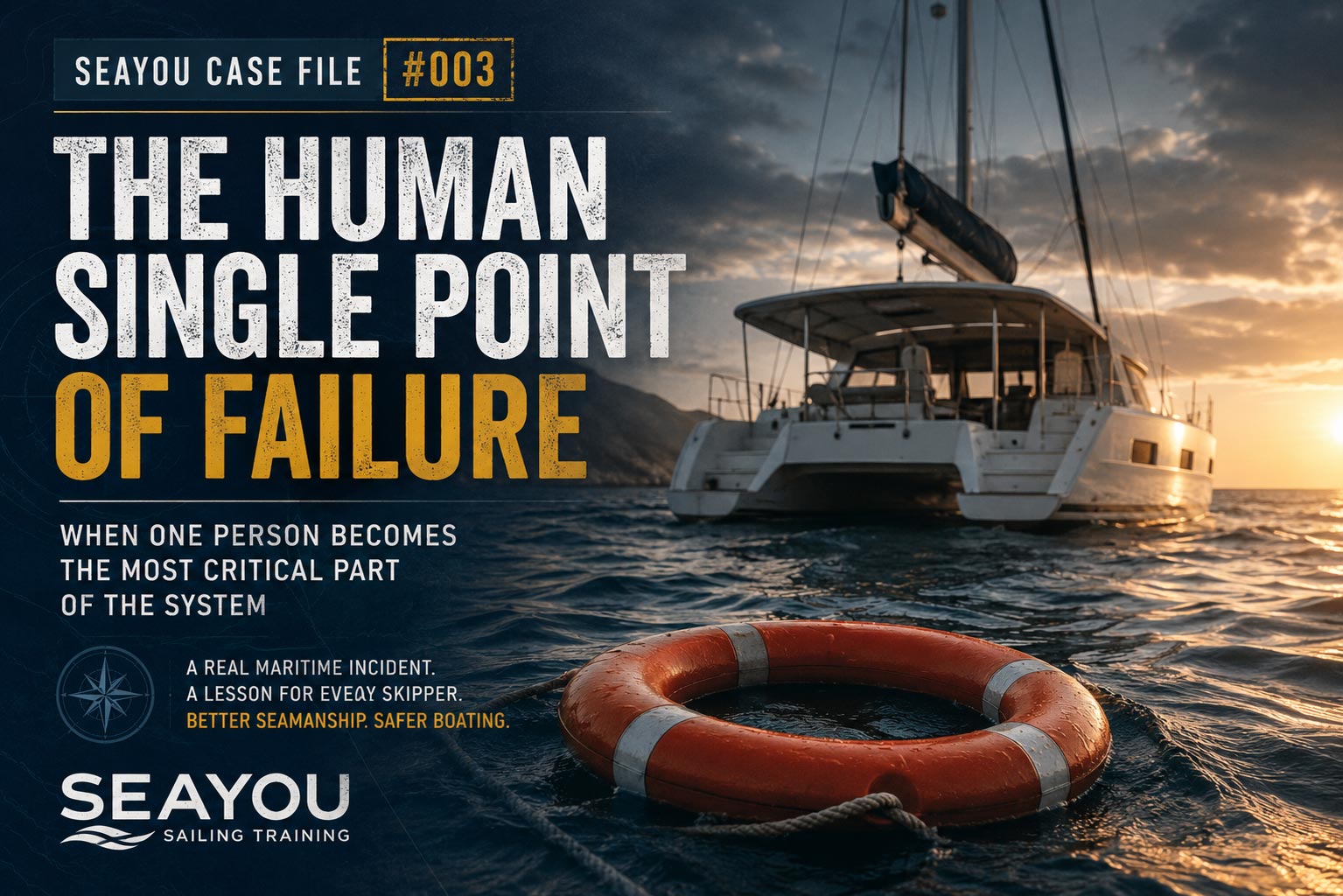
On August 17, 2026, the catamaran Theorema departed from Syracuse, Sicily, bound for Pylos, Greece.
There were two people on board.
66-year-old Spanish businessman Juan José Mutilba Obregón and his wife, Carmen.
The following morning, August 18, Juan José went overboard.
His wife was left alone on the yacht.
Approximately three days later, Greek authorities were alerted that the catamaran was about 18 nautical miles from Pylos. The yacht was located, and Carmen was safely brought ashore.
Juan José, however, remains missing.
On August 28, Italian authorities announced that the search operation had been officially called off, while the family continues to call for the search to resume.
The story is tragic.
But for a seamanship instructor, there is another, deeper question:
What happens when a boat has two people on board, but its actual operational capability depends on only one?
That is the Human Single Point of Failure.
The first and most obvious event was a Man Overboard — MOB.
A person went into the sea.
But the MOB was only the beginning of the chain.
According to the family and published reports, Juan José had caught a tuna and, while cleaning the fish, slipped and fell overboard. According to the same account, he called out to his wife to stop the engine.
Carmen, according to available reports, was unable to stop the yacht, which continued moving away from the area where Juan José had fallen.
The situation became even more difficult because there was no available mobile phone signal in the area.
Carmen remained alone on board for approximately three days before communication was established and she was able to contact a family friend. The friend then alerted the relevant authorities.
Greek authorities located the yacht approximately 18 nautical miles from Pylos and brought it safely into port.
The search for the missing man then continued.
And this is where the real training lesson begins.
In technology and risk management, a Single Point of Failure — SPOF is a component whose failure can cause the failure of an entire system.
In boating, we usually think of a SPOF as a piece of equipment.
An engine.
A GPS.
A VHF.
An autopilot.
A battery.
An electrical system.
That is why we constantly talk about redundancy.
Backup systems.
Backup batteries.
Alternative navigation methods.
A backup VHF.
But there is one SPOF that is much harder to identify.
The human.
You may have two people on board.
But if only one of them can actually:
then you have two people on board but only one real operational capability.
And that is a Single Point of Failure.
There is an important distinction here.
We do not know every detail of Carmen’s training and experience. Published reports provide different details regarding her experience and her ability to operate the particular yacht.
But that does not change the training question.
Because there is a fundamental difference between three things:
I have the legal right to operate a boat.
I am capable of operating a boat safely under real-world conditions.
I can respond when something happens suddenly, unexpectedly and under significant pressure.
License. Competence. Readiness.
Three different things.
A license may demonstrate that someone has met specific requirements.
It does not, by itself, prove that the person is ready to deal with every possible emergency.
And especially not a situation in which the person who normally operates the boat suddenly ends up in the water.
There is one element we often forget when analysing accidents after the fact.
People are not machines.
When someone watches their partner fall into the sea, they are not in a training environment.
There is no time to think.
There is no instructor beside them.
There is no checklist calmly telling them what to do, step by step.
There is fear.
Shock.
Adrenaline.
And a situation changing within seconds.
Under these conditions, theoretical knowledge can become extremely difficult to access.
That is why real training should not stop at the question:
“Do you know the procedure?”
It should reach the much more important question:
“Can you execute it when you are afraid?”
On many boats, there is a natural division of roles.
One person is the skipper.
The other is a passenger or crew member.
The skipper knows the VHF.
The other person knows where the phone is.
The skipper knows the route.
The other person knows the destination.
The skipper knows the engine.
The other person knows where the lifejackets are.
As long as everything works normally, this may seem perfectly reasonable.
Until the skipper is no longer available.
Then the system reveals its real architecture.
How much of the knowledge, capability and decision-making was ultimately stored inside one person?
Not every passenger needs to become a skipper.
But there should be at least one other person who can keep the system operational.
This could be one of the simplest safety rules on a boat:
The Second Person Rule
If the skipper can no longer act, someone else must be able to perform the first critical actions.
Not become an expert overnight.
But be able to:
Know how to stop the engine.
Know how propulsion is shut down.
Know how to secure the boat.
Be able to maintain basic control of the boat.
Know the essential controls of that particular vessel.
Know where the VHF is.
Know how to make a MAYDAY call.
Be able to communicate the boat’s position.
Know where the following are located:
You do not need to know every technical term.
But you must know what it is, where it is and how it is used.
“Where are we?”
Not theoretically.
Practically.
You should be able to access the appropriate system and give a rescuer an accurate position.
A boat may have:
GPS.
Chartplotter.
AIS.
VHF.
EPIRB.
PLB.
Emergency equipment.
And still remain vulnerable.
Why?
Because having the equipment does not mean having the ability to use it.
We don’t just need:
Two VHFs.
We need:
Two people who know how to use the VHF.
We don’t just need:
Two navigation systems.
We need:
Two people who can determine the boat’s position.
We don’t just need:
Emergency equipment.
We need:
People who know where it is and how to use it.
That is real redundancy.
There is a very simple exercise that should be practised much more often.
Not theoretically.
Practically.
In safe conditions, the skipper temporarily hands over control and says:
“Assume that from this moment on, I cannot help you.”
The second person should then be able to answer:
Where are we?
How do we stop the boat?
How do we control it?
How do we call for help?
Where is the VHF?
How do we make a MAYDAY call?
Where is the emergency equipment?
What is our position?
If one of the answers is:
“I don’t know.”
that is not failure.
It is a training gap.
And a training gap is much better discovered on a calm afternoon in the marina than during a real emergency.
This is perhaps the most important point of this Case File.
A Single Point of Failure does not necessarily mean:
“Someone did something wrong.”
It may mean:
“The system was designed without sufficient redundancy.”
A skipper can be excellent.
Experienced.
Certified.
Careful.
With thousands of miles under their belt.
And yet, if nobody else on board can take over the basic functions when that skipper becomes unavailable, the system remains vulnerable.
That is not necessarily a problem with the person.
It is a problem with the design of the system.
The lesson from this story is not:
“Learn how to operate a boat.”
It is much bigger than that.
Do not allow the entire system to depend on one person.
Because at sea, things can change within seconds.
The skipper can fall overboard.
Become injured.
Lose consciousness.
Suffer a serious medical emergency.
Become unable to communicate.
And suddenly, the person we considered “the second person” becomes the only person capable of keeping the boat and everyone on board safe.
The wrong question is:
“Who is the skipper?”
The right question is:
“If the skipper suddenly cannot act, who can keep the system operational?”
If the answer is:
“Nobody.”
then we have identified a Single Point of Failure.
And the most important part?
We have identified it before the accident happens.
A safe boat is not necessarily one where one person knows everything.
It is one where the loss of one person does not automatically mean the loss of the system’s ability to function.
That is Seamanship.
Not simply knowing how to move a boat from A to B.
But thinking about what happens when something stops working.
And sometimes that “something” is not the engine.
It is not the GPS.
It is not the VHF.
It is the human.
Two people on board do not automatically mean two capable operators.
If only one person can:
then the boat may have two people on board.
But it functions as if it has one.
And that one person is the Single Point of Failure.
Real training should not create dependence on one person.
It should create redundancy, confidence and resilience.
Because the most dangerous moment is not always when something breaks.
It may be when:
the person who knew what to do can no longer do it.
Based on a real maritime incident and examined from a seamanship and training perspective.
The incident is based on publicly reported information. The conclusions of this Case File are intended as an educational analysis of the human factor and not as an attribution of responsibility to the people involved.