
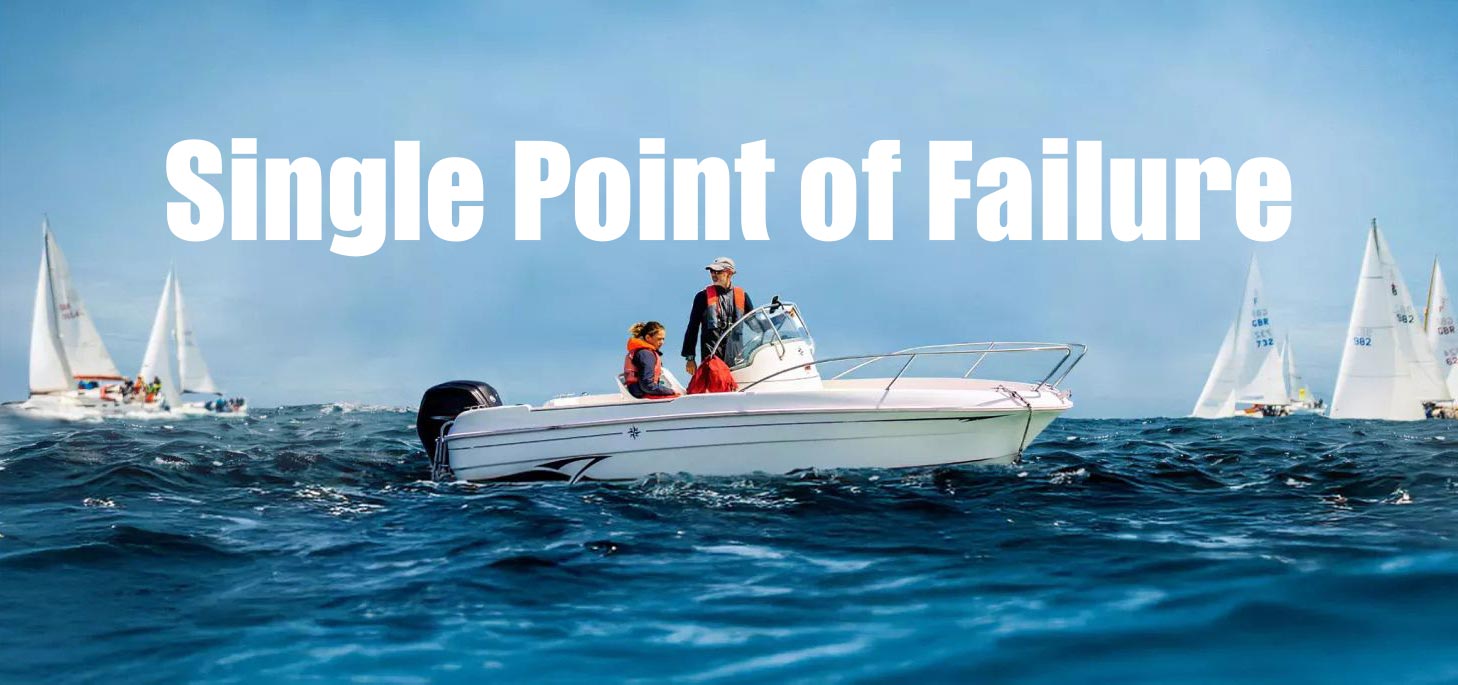
The Human Single Point of Failure on Small Boats: Are You the Only Skipper or the Biggest Risk On Board?
Most skippers spend years improving their boat handling, navigation, anchoring, and weather interpretation skills. They learn how to dock in crosswinds, plan safe passages, read marine forecasts, and handle unexpected equipment failures.
Yet, one of the greatest risks on board is rarely discussed in sailing courses, charter briefings, or marina conversations: the skipper themselves.
This is not because skippers are careless or lack competence. It happens because many unintentionally become the boat’s Single Point of Failure (SPOF).
What Is a Single Point of Failure in Boating?
A Single Point of Failure exists when one component, system, or individual becomes indispensable to an operation. If that critical component fails, the entire system is compromised.
Modern industries spend enormous amounts of time and money eliminating these vulnerabilities through redundancy and cross-training personnel:
- IT Networks: Running multiple backup servers to prevent total downtime.
- Corporate Security: Cross-training employees so critical knowledge is shared.
- Commercial Aviation: Utilizing co-pilots and bridge teams instead of relying on a single individual.
According to risk management principles used by organizations like the U.S. Coast Guard, safety depends on eliminating these vulnerabilities. Yet, on recreational boats and charter yachts, we often do exactly the opposite. We place almost all critical knowledge in the hands of one person: the skipper.
Why the Skipper Can Be the Most Dangerous Risk On Board
The statement may sound controversial, but consider how many times you have seen a small boat where only one person knows:
- How to operate the VHF radio
- How to start or troubleshoot the marine engine
- How to navigate back to port using the chartplotter
- How to make an emergency distress call
- How to anchor safely in rough weather
- How to communicate with the Coast Guard
For many crews, the answer is simple: only the skipper.
While this centralized control may look like competence, it creates a severe vulnerability. The irony is that a skipper who believes they are increasing safety by controlling everything is actually reducing it.
The Dangerous Myth of the “Hero Skipper”
Sailing culture sometimes celebrates the image of the omnipotent skipper who handles every maneuver, makes every decision, and solves every problem alone.
Professional aviation abandoned this “hero pilot” mentality decades ago. High-performance organizations understand a simple truth: the strongest systems are built around resilient teams, not exceptional individuals.
Being indispensable is not a sign of advanced skipper skills. It means your system depends too heavily on you, and heavy dependence always creates risk.
What Happens If the Skipper Is Suddenly Incapacitated?
Most skippers have practiced a standard Man Overboard (MOB) drill. Far fewer have considered a much more uncomfortable question: What happens if the person who falls overboard is you?
Imagine how your crew would handle these three critical marine emergencies:
1. The Skipper Falls Overboard
The crew is left on board with the engine running and the boat moving. As panic sets in, who takes command? Who operates the radio, coordinates the recovery procedure, and navigates the vessel back to safety?
2. A Sudden Medical Emergency
A sudden illness, a severe allergic reaction, a cardiac event, or a head injury sustained during docking can instantly take a skipper out of action. Can anyone else safely bring the vessel into port or provide emergency services with an accurate position report?
3. Skipper Fatigue and Exhaustion
Not all failures are sudden. Fatigue is a highly underestimated threat at sea. An exhausted skipper may still appear functional while suffering from reduced awareness, slower reaction times, and impaired decision-making. If no one can share the load, fatigue becomes an active operational risk.
The Hidden Risk of Charter Yacht Vacations
This vulnerability appears regularly in the charter world. A group of friends or family members charters a yacht, one person holds the sailing certificate, and everyone else becomes a passenger.
The skipper is forced to simultaneously act as:
- Navigator & Helmsman
- Marine Engineer
- Safety & Communications Officer
- Weather Router & Problem Solver
This arrangement feels normal until something goes wrong. Many sailors discover this reality during their first independent charter. The gap between holding a sailing certificate and possessing real-world skipper confidence is often much larger than expected.
A certificate proves you met a standard on a particular day. It does not automatically prepare you to manage a week-long charter with an untrained crew.
How Professional Maritime Operators Think Differently
Professional maritime crews understand that human beings are fallible. Instead of concentrating knowledge, they distribute it by using five core operational principles:
- Cross-Training: Ensuring more than one person understands essential tasks.
- Comprehensive Briefings: Making sure everyone knows the navigation plan and the risks.
- Shared Situational Awareness: Ensuring the crew knows where the vessel is and what challenges lie ahead.
- Smart Delegation: Sharing active responsibilities rather than centralizing them.
- Continuous Learning: Reinforcing practical skills through regular on-board practice.
5 Things to Teach Your Crew Before Leaving the Marina
A proper yacht safety briefing should go far beyond pointing out where the lifejackets are stored. Before leaving the dock, ensure at least one other crew member masters these five basic boat training skills:
- How to Stop the Boat: Teach them engine controls, neutral position, ignition, and emergency stop procedures.
- How to Use the VHF Radio: Ensure at least two people on board can confidently operate the radio to make a marine distress call. Review the International Maritime Organization (IMO) radio protocols for safety.
- How to Identify the Boat’s Position: Show your crew how to read coordinates on the chartplotter and communicate that position to emergency services.
- Where Safety Equipment Is Located: Review the exact locations of lifejackets, liferaft, first aid kit, fire extinguishers, flares, and emergency steering equipment.
- What To Do If the Skipper Is Incapacitated: Create a clear chain of command so the crew knows who takes over if you are unable to command.
Leadership at Sea: True Seamanship Is About Creating Capability
One of the biggest transitions in a skipper’s development occurs when they stop trying to do everything themselves. The best skippers do not create dependence; they create capability. They explain their decisions, involve their crew, delegate responsibility, and build confidence in others.
True leadership at sea is not about proving how much you know. It is about ensuring the vessel remains safe even when circumstances change unexpectedly.
The Ultimate Skipper Test
Ask yourself this one honest question: If I disappeared from this boat right now, could my crew safely bring everyone home?
If the answer is yes, you have built a resilient crew. If the answer is no, then the greatest risk on board is not the weather, the sea state, or the equipment—it is the fact that too much depends on you.
Most sailing accidents are not caused by a failure of technology. Modern yachts are remarkably capable. Accidents happen due to a lack of operational resilience.
Ready to Move Beyond Your Sailing Certification?
If your goal is to develop genuine skipper confidence, practical command experience, leadership skills, and real-world maritime decision-making abilities, explore our specialized training solutions on SeaYou.gr:
- Charter Confidence Programme: Master the practical skills needed to manage a stress-free charter vacation with family and friends.
- Skipper Development Programme: Transition from a certified sailor to a resilient commander who knows how to train a capable crew.