
 +30 697.38.37.123
Info@SeaYou.gr
+30 697.38.37.123
Info@SeaYou.gr
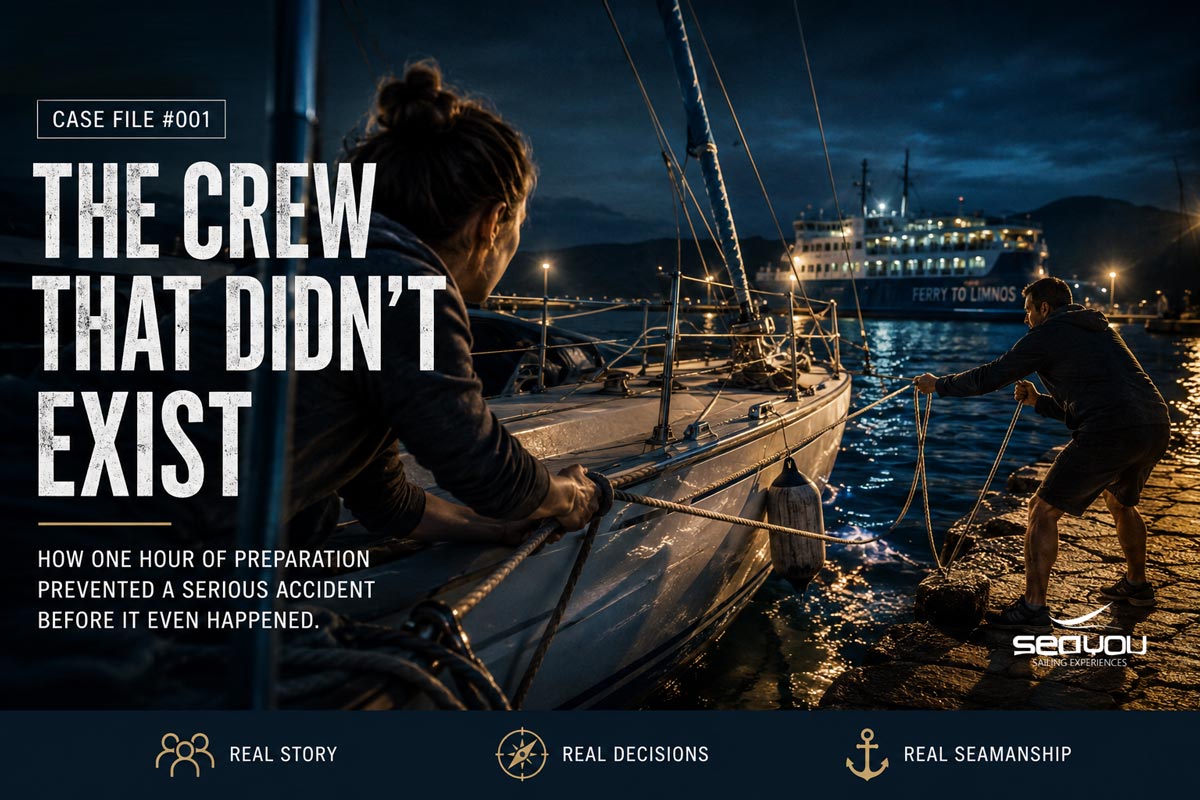
How one hour of preparation prevented a serious accident before it even happened. Category: SeaYou Case Files | Reading Time: 10 min
Sometimes, the crew that saves your boat is the one you create right before you need it.
Every skipper has a story about rough weather, engine failures, or difficult manoeuvres. This is not one of them.
This is the story of a calm spring evening, a quiet fishing harbour, and three friends who had never stepped aboard a sailing yacht before. It is also the story that fundamentally changed how I approach leadership at sea.
Because that night, I learned a truth I have carried with me ever since:
Emergencies rarely give you time to train your crew. Preparation always happens before the crisis.
It was early May. The sailing season had barely begun when we cast off from Kavala aboard a Dufour Classic 45, heading south towards Kassandra, Halkidiki.
The weather forecast looked favourable. The sea was calm. Our first overnight stop was planned for Limenaria, Thassos.
Or at least, that was the plan.
A few hours into the passage, something felt off. The engine refused to reach its normal RPM. No alarms sounded. No smoke appeared. No unusual vibrations were felt. Just… a mysterious loss of power.
Nothing suggested immediate danger, but something was clearly wrong. Rather than push forward into the unknown, I made the call to shorten our day and head for Skala Marion—a small harbour on the southwest coast of Thassos.
Looking back, that decision prevented a much bigger crisis later. At the time, however, it felt like nothing more than a minor inconvenience.
The people traveling with me were close friends. They weren’t sailors, they weren’t nautical students, and they certainly weren’t crew. They had joined the trip for the exact reason most people charter a yacht: to relax, enjoy the sea, and unwind.
Most skippers in that situation would tell their guests to pour a drink and enjoy the view.
I chose a different approach.
During the passage, I spent roughly an hour teaching them the absolute basics:
How to handle a mooring line.
How to throw it effectively.
How to secure it properly on a cleat.
How to communicate using short, clear terms.
How to react instantly to a direct command.
It wasn’t a formal lecture or a sailing course—just simple, practical preparation. At the time, none of us realised how crucial that single hour would prove to be.
We entered Skala Marion late in the afternoon. The harbour was well-protected and perfectly calm.
We completed our mooring seamlessly: bow line, stern lines, and two springs. Every line was checked twice and properly tensioned. By every reasonable standard, the yacht was safely secured for the night.
As darkness fell, the harbour settled into a relaxed atmosphere. People were having dinner ashore.
In the distance, I noticed the regular ferry passing on its route towards Limnos, eventually disappearing into the dark horizon. I didn’t think much of it. The water around us remained still.
Or so I thought.
There is a saying among seasoned sailors: The sea doesn’t always warn you before it tests you.
That night, the test didn’t come from a sudden squall, a shift in the wind, or a mechanical failure. It came from a hidden wave.
About twenty minutes after the ferry had passed, its wake finally reached the narrow entrance of Skala Marion. At first, it looked insignificant.
Then the water inside the harbour began to displace.
The Dufour Classic 45 started surging violently back and forth as the trapped energy of the wake bounced off the stone walls. Every wave pushed the yacht forward, then violently yanked her back, placing immense, dynamic loads on the mooring lines.
We weren’t drifting; we were fighting pure physics. Every surge increased the tension; every rebound multiplied it. Within seconds, a peaceful night had turned into an active emergency.
Then came the snap.
Crack.
The bow line parted under the violent load. As the line snapped, the bow immediately swung away from the quay.
The risk escalated instantly. The problem was no longer just uncomfortable boat movement—it was severe structural damage. With the bow swinging free, the stern was now violently exposed, threatening to smash into the concrete dock with every incoming surge. Gelcoat, fiberglass, rudder, steering gear… thousands of euros in damage were seconds away.
There was no time for explanations. No time for debate. Only time to act.
Without hesitation, I jumped onto the quay and issued a single, concise instruction. No shouting, no panic, no long descriptions.
The command was understood instantly—because it wasn’t the first time they had heard it.
Vasileia, who only hours earlier had never held a winch handle or a mooring line, acted instantly. She didn’t freeze. She didn’t ask “what do you mean?”. She didn’t look around for someone else to step in.
She grabbed the spare line I had laid out earlier “just in case” and worked seamlessly with me from the deck to secure the bow before the stern could strike the quay.
It was over in seconds. Seconds that would not have existed had my friends remained passive passengers.
The spare mooring line didn’t save the yacht. The prepared person holding it did.
Once the yacht was re-secured, silence returned to the harbour. The immediate danger had passed.
Before calling it a night, I double-checked the ferry schedules. Would another vessel pass? Would another wake hit? Could our new line configuration handle another surge?
Only when those questions were satisfied did I allow myself to rest. My friends went to sleep peacefully, completely unaware of how close we had come to disaster.
I barely slept. Twice during the night, I woke up to inspect every line, cleat, and fender.
Not because I expected a failure—but because that is what leadership requires. When everyone else slumbers, the skipper remains vigilant.
When people hear this story, they usually focus on the broken line. Was it worn out? Should it have been thicker? Should we have used snubbers?
These are valid technical questions, but they miss the larger point. The broken line was not the root problem—it was merely the trigger that exposed our vulnerability.
Incidents at sea are rarely caused by a single dramatic event. They are almost always the final link in an invisible chain of small, seemingly unrelated decisions:
The Hidden Variable: Marine growth (mussels) on the propeller from the winter lay-up reduced our engine efficiency. (I had to dive into 14°C water the next morning to scrape it clean).
The Resulting Pivot: Reduced power forced us to change our plan and seek shelter in Skala Marion.
The Unseen Risk: A passing ferry generated a delayed wake that bounced off the harbour walls.
The Failure Point: The dynamic load snapped an otherwise adequate line.
Good seamanship isn’t just about handling the final failure; it’s about recognizing the chain before the final link breaks.
Many skippers assume having extra gear on board is their contingency plan. It isn’t.
A spare line sitting in a locker or on a deck holds zero value if no one knows where it is, how to cleat it, or when to deploy it. Equipment doesn’t solve emergencies; trained people using equipment do.
Imagine this exact scenario with an unprepared crew:
The line breaks.
The skipper jumps ashore.
The guests freeze in confusion.
Questions replace action.
Seconds slip away while the stern smashes into the dock.
In that scenario, the skipper becomes a Single Point of Failure. They have to assess, instruct, retrieve equipment, secure lines, and manage panic all by themselves.
By taking one hour during a calm passage to share basic operational knowledge, I decentralized that responsibility. The emergency was still mine to lead, but it was no longer mine to fight alone.
When I replay that night, I don’t remember the loud snap of the bow line.
I remember watching someone who had never stepped on a boat before calmly execute a line-handling manoeuvre under pressure because someone took the time to prepare her earlier that day.
Training isn’t reserved for commercial crews, naval academies, or extreme offshore passages.
Every time we take guests out to sea, we assume responsibility for their lives and safety. They don’t need to become master mariners overnight—but they should never be left entirely helpless.
The most valuable piece of safety equipment on our yacht that night wasn’t the heavy-duty spare line, the engine, or the fenders.
It was one hour. One hour invested in people.
Train your crew before you need your crew. Because the sea is a terrible classroom during an emergency.