 +30 697.38.37.123
Info@SeaYou.gr
+30 697.38.37.123
Info@SeaYou.gr
“If one does not know to which port one is sailing, no wind is favorable.”
— Seneca
There are sentences that survive for centuries because they describe something fundamental about being human.
This is one of them.
For a sailor, its meaning is almost instinctive.
If you know where you are going, the wind becomes information.
You can work with it. You can sail against it. You can tack. You can wait. You can alter your route.
But if you do not know your destination, every change in the wind can become a reason to change direction.
And there is a profound difference between changing your route and losing your direction.
At sea, that difference can determine whether a passage is simply difficult or genuinely dangerous.
In life, it can determine whether we are adapting — or simply drifting.
When we talk about passage planning, we often start with the practical questions.
What is the weather?
Which route should we take?
How much fuel do we need?
What is our expected speed?
Where are the hazards?
Where can we stop?
All of these questions matter.
But before them comes another question:
Where are we going?
The destination is not merely a point on the chart.
It is the reference against which every other decision is measured.
A particular wind can be favourable for one passage and completely unsuitable for another.
A certain route can be efficient under one set of conditions and unnecessarily risky under another.
Even turning back can be either a failure or a perfectly rational seamanship decision — depending on what the circumstances require and what you are trying to achieve.
This is why good seamanship is not about following a route with stubborn precision.
It is about understanding why that route was chosen in the first place.
Because when reality changes, the route may need to change too.
The destination may not.
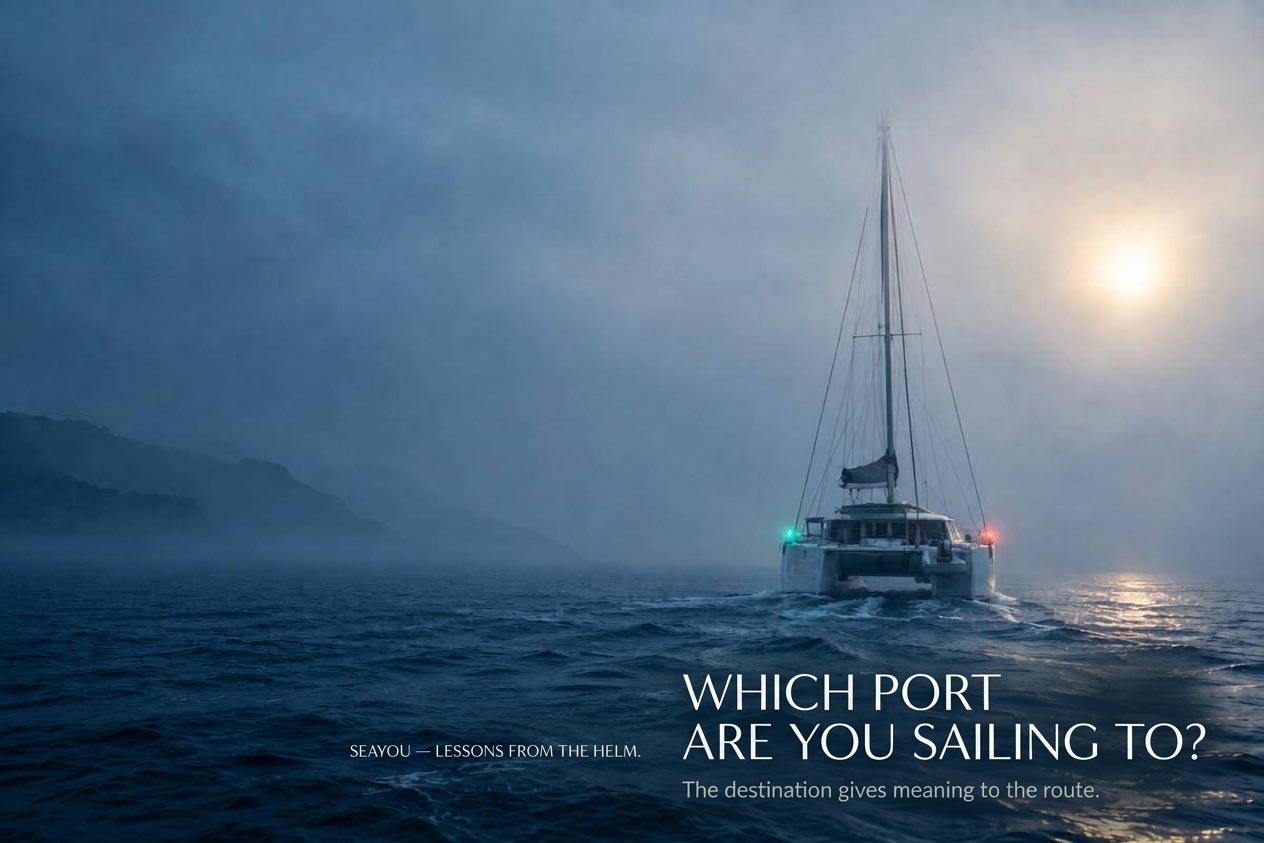
Several years ago, during a long catamaran transfer from the western coast of France toward Greece, five catamarans were making the passage together.
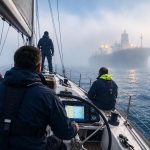
At some point, while we were off the coast of Algeria, visibility began to deteriorate.
Then it became fog.
Not the kind of fog that simply makes the horizon disappear.
At times, the visibility was so poor that looking from the stern, you could not see the bow.
The conditions were changing constantly.
For a group of five boats travelling together, this created another problem: traffic.
The original plan was straightforward.
If the boats became separated, the leader had established a specific rendezvous point and a specific time at which the boats could regroup.
It was a sensible contingency plan.
But the sea does not care how sensible your plan was when you made it.
As traffic increased, the situation changed.
The original route was no longer the most practical option.
The instructions changed.
The boats began making repeated alterations.
Zigzags replaced the original straightforward passage.
Then visibility would improve.
Then the fog would return.
Sometimes for a few hours the conditions were manageable.
At other times, they became extremely restrictive.
The passage continued like this for approximately three days.
And this is where the story becomes interesting.
Because the most important decision was not about the fog.
It was about what to do when the original strategy was no longer working.
One of the most dangerous habits in navigation is becoming emotionally attached to the original plan.
We prepare a route.
We study the weather.
We calculate the passage.
We brief the crew.
And then, once underway, we subconsciously start treating the plan as something that must be defended.
But a passage plan is not a promise to reality.
It is a framework for making decisions.
When circumstances change, the plan must be allowed to change with them.
During that transfer, the traffic made the original strategy increasingly difficult.
The obvious response could have been to continue making small adjustments.
A little to port.
A little to starboard.
Avoid one vessel.
Then another.
Change course again.
And again.
But eventually, constant reaction becomes its own problem.
You are no longer choosing your route.
You are simply responding to what is immediately in front of you.
That is when a skipper — or a leader — needs to step back and look at the situation differently.
Not:
“How do we deal with the next problem?”
But:
“Is there a different strategy that removes the problem altogether?”
The leader of the transfer, Christoforos, made a decision that initially might not have seemed obvious.
Instead of continuing to fight the traffic offshore, the group moved closer to the coast.
We entered the territorial waters of Algeria and later Tunisia, operating approximately between 12 and 8 nautical miles from the coastline.
It was a bold decision.
But it changed the problem.
Instead of continually negotiating with heavy offshore traffic in extremely restricted visibility, we found ourselves in an environment where the traffic situation was significantly different.
The route had changed dramatically.
The objective had not.
And that distinction matters.
Because leadership at sea is not about demonstrating that the original plan was correct.
It is about recognising when reality has invalidated part of the plan — and having the judgement to build a better one.
The decision worked.
We continued the passage.
This is where Seneca’s old sentence becomes much more than a philosophical quotation.
We knew where we were going.
That gave us freedom.
Freedom to change course.
Freedom to reconsider the original route.
Freedom to abandon a plan that was no longer serving its purpose.
And freedom to make a decision that, on a chart, might initially look like a significant deviation.
The destination remained the reference point.
The route was simply a means of getting there.
This is one of the most important distinctions in seamanship:
The route is not the objective.
The route is a tool.
And tools can be changed.
There is a misconception that a good skipper is someone who sticks to the plan.
That is not necessarily true.
A good skipper understands the plan well enough to know when it should no longer be followed.
That requires more than technical knowledge.
It requires situational awareness.
It requires the ability to distinguish between a temporary inconvenience and a fundamental change in circumstances.
It requires the courage to say:
“This is no longer the best way.”
And perhaps most importantly, it requires the absence of ego.
Because sometimes changing the plan can feel like admitting that the original plan was wrong.
It wasn’t necessarily wrong.
It was simply created using the information available at the time.
The sea provided new information.
So the decision had to evolve.
That is not failure.
That is seamanship.
This distinction is worth remembering.
Course is what the boat is doing now.
Direction is where you are trying to go.
They are not always the same.
A sailing yacht may have to steer away from its destination to make progress toward it.
A skipper may have to turn around to reach a safer port.
A flotilla may have to abandon its planned route because conditions have changed.
A business may have to change its strategy without changing its mission.
A person may have to change careers without abandoning the values that led them there.
The temporary direction of travel can change.
The destination can remain.
And sometimes, changing the course is precisely what allows you to preserve the direction.
There is another lesson hidden in the fog.
When visibility is poor, your attention naturally narrows.
You start looking at what is immediately around you.
A contact on AIS.
A vessel appearing through the fog.
A change in heading.
Another alteration.
Another decision.
This is understandable.
But leadership requires something else.
At some point, someone has to lift their eyes — metaphorically, if not literally — and ask:
What is actually happening here?
Are we solving the problem?
Or are we simply reacting to it?
Are we still following a strategy?
Or have we entered a cycle of continuous reaction?
And perhaps the most important question:
Is there a way to change the environment instead of constantly fighting it?
That last question led to the decision that changed the passage.
The answer was not to become better at avoiding every individual ship.
The answer was to change the route so that the traffic itself became less of a problem.
Modern navigation gives us extraordinary capabilities.
GPS tells us where we are.
AIS helps us understand traffic.
Electronic charts show us hazards.
Weather systems provide forecasts.
Routing software can calculate possible passages.
Yet none of these tools can make the fundamental decision for us.
They can tell us where we are.
They can help us understand what is around us.
But they cannot determine where we should go.
That remains a human decision.
This is why technology can never replace seamanship.
And it is also why navigation is not simply about position.
It is about context.
A GPS position without understanding is just a coordinate.
An AIS target without interpretation is just information.
A weather forecast without a decision-making framework is simply data.
The skipper’s job is to transform information into judgement.
This is where Seneca’s words become uncomfortable.
Because the same thing happens on land.
We often believe that what we need is better weather.
Better opportunities.
More money.
More time.
Better circumstances.
The right people.
A little more luck.
But sometimes the real problem is that we have never clearly decided which port we are sailing toward.
Without a destination, every opportunity can look attractive.
Every new direction can seem exciting.
Every change can feel like progress.
And we can spend years moving without actually arriving anywhere.
We confuse activity with progress.
We confuse options with direction.
We confuse movement with purpose.
The sea is very good at exposing that mistake.
Because a boat can be moving fast and still be going the wrong way.
Knowing your destination does not mean you are never allowed to change it.
That would be another form of rigidity.
Perhaps halfway through the journey, you discover that another port is more important.
Perhaps circumstances change.
Perhaps you learn something you did not know before.
Perhaps the destination you originally chose no longer represents what you want.
That is different from drifting.
There is a difference between saying:
“I have reconsidered where I want to go.”
and:
“I have no idea where I am going, so I will follow whichever wind feels strongest today.”
The first is conscious change.
The second is reaction.
I think back to those days in the fog.
Five catamarans.
Three days of difficult visibility.
Traffic.
Constant course changes.
A plan that had to evolve repeatedly.
And eventually, a decision to stop fighting the same problem and change the strategy.
What stayed constant was not the course.
It was the destination.
That is perhaps the simplest definition of leadership I can think of:
Knowing what must remain constant — and being willing to change everything else.
Christoforos, as the leader of that transfer, demonstrated something that cannot be learned simply by reading a navigation manual.
The ability to look beyond the immediate problem.
To recognise that the situation had changed.
To make a bold decision.
And to keep the group moving toward the objective.
The sea did not become easier.
The fog did not suddenly disappear.
The traffic did not cooperate.
The strategy changed.
And that was enough.
Perhaps this is the question we should ask ourselves more often.
Not only when we are standing at the helm.
But when we are making decisions about our careers.
Our businesses.
Our relationships.
Our education.
Our ambitions.
Our next chapter.
Which port are you sailing to?
Because once you know, the wind becomes something you can work with.
A change of course becomes an adjustment rather than a crisis.
An obstacle becomes a problem to solve.
A setback becomes information.
And an unexpected route does not necessarily mean that you are lost.
Sometimes it means that you are navigating.
You will not always get the wind you want.
You will not always have clear visibility.
You will not always have the perfect conditions.
And sometimes, the route you planned will become impossible.
That’s okay.
Change the route.
Reassess the conditions.
Use the information available to you.
Listen to the people around you.
Make the decision.
And if necessary, turn the boat.
But keep asking yourself one question:
Because when you know your destination, even an unexpected wind can become useful.
And when the fog comes, you may not be able to see the port.
But you can still know that it is where you are going.
The sea rarely gives us exactly the conditions we planned for.
Neither does life.
The skill is not to wait for perfect conditions.
It is to know where you are going well enough to adapt when the conditions change.
The destination gives meaning to the route.
And sometimes the best navigation decision you can make is not to sail harder.
It is to change course.
— Antonis Meis
SeaYou — Explore. Learn. Dive.
For the decisions made when visibility disappeared, for the courage to change the plan when circumstances demanded it, and for never losing sight of where we were going.