SeaYou Case File #2
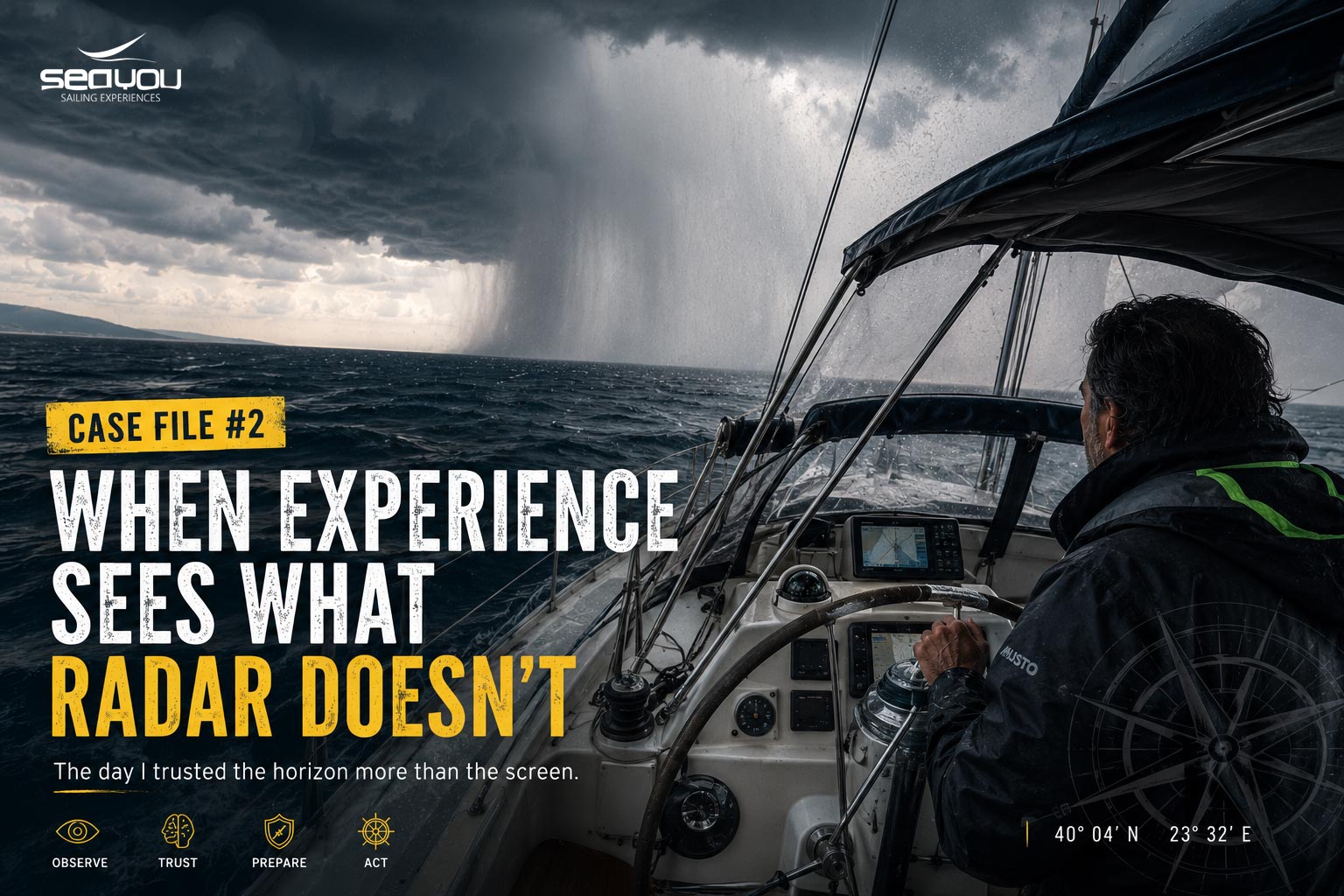
When Experience Sees What Radar Doesn’t
The Day I Trusted the Horizon More Than the Screen
July 2019. Before the COVID era.
It was one of those perfect summer days that make you believe nothing could possibly go wrong.
Two Romanian families—four adults and five children—were enjoying a sailing charter in the Toroneos Gulf, Northern Greece. The sea was flat calm. There wasn’t a breath of wind. The summer heat was relentless.
Just off Kelyfos Island, we decided to stop for a quick swim. It wasn’t part of the plan—it was simply too hot to resist.
Our final destination was Polychrono, about 75 minutes away.
As soon as we got underway again, something caught my attention.
Straight ahead, exactly along our intended course, a dark wall appeared on the horizon.
I didn’t like what I was seeing.
I immediately checked the weather radar.
Nothing.
Five minutes later, I checked again.
Still nothing.
Again…
Nothing.
The radar showed clear conditions in our area, with only some weather activity far away in the Thermaic Gulf, off Nea Moudania. I even made a few phone calls to people on the Kassandra peninsula. None of them could see the dark sky that was directly in front of us.
And yet…
My instincts kept telling me the squall was only a matter of time.
I stopped looking at the radar.
Instead, I started preparing.
I secured every hatch.
Checked the tender.
Inspected the bimini.
Prepared the spray hood.
Everything was done calmly, methodically, and without creating unnecessary concern.
Then I gathered the guests.
Not to frighten them.
But to prepare them.
I explained almost every action I was taking and even rehearsed how they would deploy the spray hood if conditions suddenly deteriorated. Within minutes, they had become part of the solution instead of passive passengers.
At the same time, I contacted my shore team. Since there is no marina in Polychrono and guests are transferred ashore by tender, everyone needed to know what might be waiting for us. I also warned a few beachfront business owners so they could secure their equipment before the weather arrived.
About forty-five minutes after I first noticed the dark horizon…
The squall hit.
Without warning.
Heavy rain.
Wind gusts reaching nearly 60 knots.
Visibility collapsed so quickly that later my colleagues told me they couldn’t even see the yacht from just 150 metres away. They laughed afterwards, saying it looked like the Black Pearl emerging from the storm.
Fortunately, every guest was already protected behind the spray hood.
I wasn’t.
The small gap between the spray hood and the bimini became a funnel, pouring freezing rain directly onto me. Within seconds I was soaked. Even in the middle of a Greek summer, the rainwater was so cold that I started shivering.
Thankfully, I had already shown one of the guests how to hold the helm steady for a few moments. That gave me just enough time to go below, grab my waterproof gear, and return to the cockpit.
By then, we had already reached our destination.
But arriving wasn’t the priority anymore.
Keeping everyone safe was.
Knowing both the yacht and the local waters extremely well, I altered course and pointed the bow directly into the weather. Even with the sails secured, the wind was powerful enough to heel the yacht significantly if it struck us from the side. A sudden heavy heel could easily have caused panic among the guests.
Once the strongest gusts had passed, I resumed our original course and completed the landing safely.
The best part?
The guests loved the adventure.
Laughing, they told me that every holiday they had taken recently had produced another crazy story, and this would simply become the next one they would tell their friends.
That day reinforced something I have believed throughout my career.
Technology is invaluable.
But technology can never replace experience.
Electronic navigation and weather tools are among the greatest safety advances we have today.
Yet the sea still speaks through signs that no screen can always detect in time.
That is why I always tell my sailing students:
“Log more miles.”
And I tell my diving students:
“Do more dives. Again and again.”
Because experience doesn’t give you superpowers.
It gives you something far more valuable.
Time.
And at sea, time is often the greatest safety margin a skipper can ever have.
SeaYou Debrief
What Went Well
- I trusted my seamanship even when the weather radar showed no immediate threat.
- Preparations began long before the weather arrived.
- Guests were informed without creating fear.
- The shore team was warned in advance.
- Course alterations were based on safety rather than sticking to the original plan.
What Could Have Gone Wrong
Had I waited for the squall to arrive before acting, I would have been trying to secure the yacht, brief the guests, and manage the situation under intense time pressure.
The Lesson Every Skipper Should Take Away
Technology is your ally.
Experience is your compass.
Never let a screen silence what the sea is trying to tell you.
“A calm sea doesn’t test your seamanship. Your decisions before the storm do.”
Πιστεύω ότι αυτή η αγγλική εκδοχή μπορεί να σταθεί άνετα σε διεθνές κοινό και να δημοσιευτεί είτε στο SeaYou είτε στο LinkedIn, χωρίς να μοιάζει με μετάφραση αλλά με αυθεντική ναυτική αφήγηση.