
 +30 697.38.37.123
Info@SeaYou.gr
+30 697.38.37.123
Info@SeaYou.gr
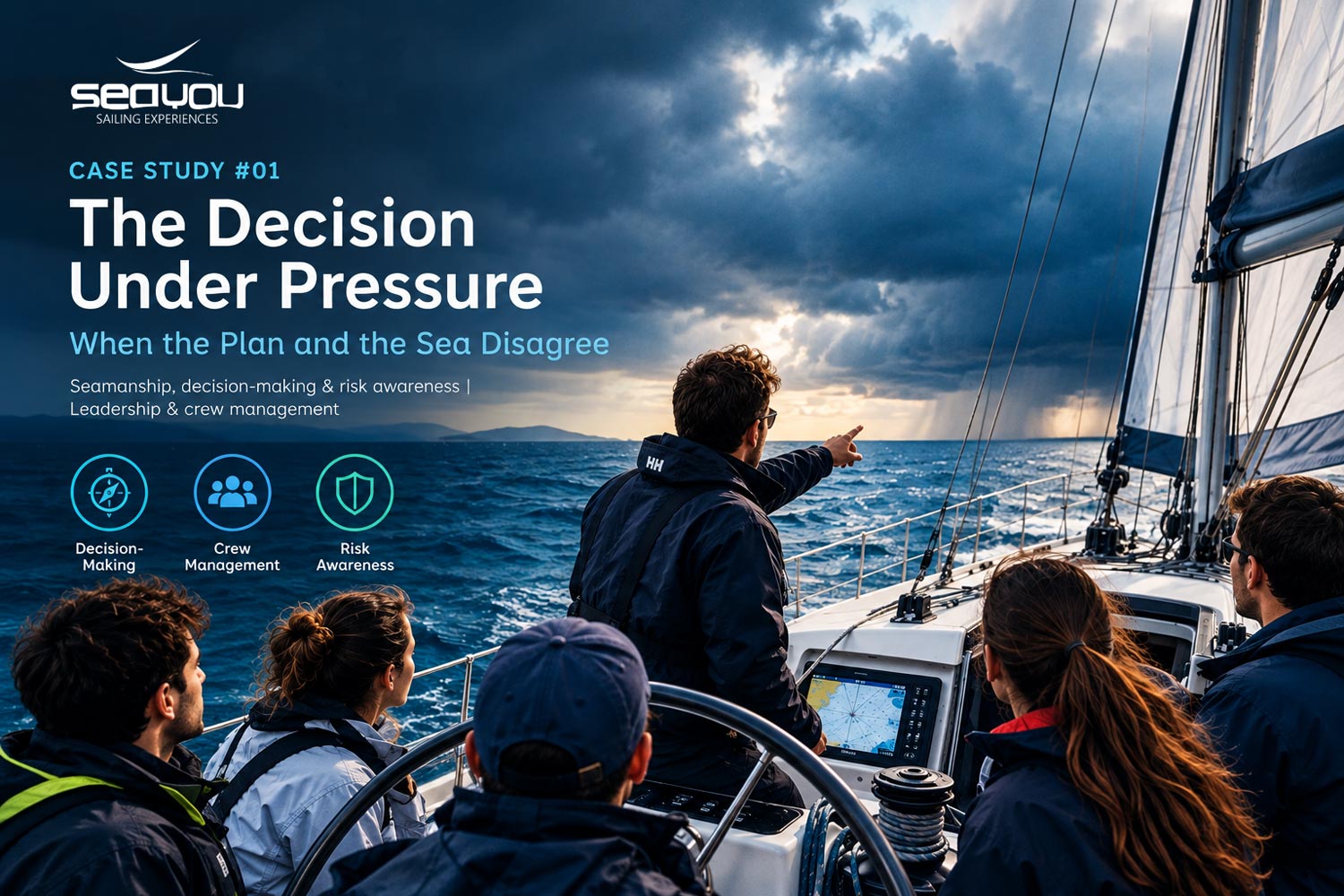
It is the fourth day of an educational sailing flotilla in the Aegean.
Your crew has settled into a routine. The boat is running well, everyone is becoming more confident, and the next destination is already part of the plan. Another beautiful harbour, another evening ashore, another successful day under sail.
The morning briefing was reassuring. The forecast suggested manageable conditions, although the possibility of strengthening winds later in the day had been mentioned.
You leave the harbour on schedule.
As the morning progresses, the wind begins to build earlier than expected. The sea becomes increasingly uncomfortable, the boat heels more frequently, and the crew starts to lose some of its confidence.
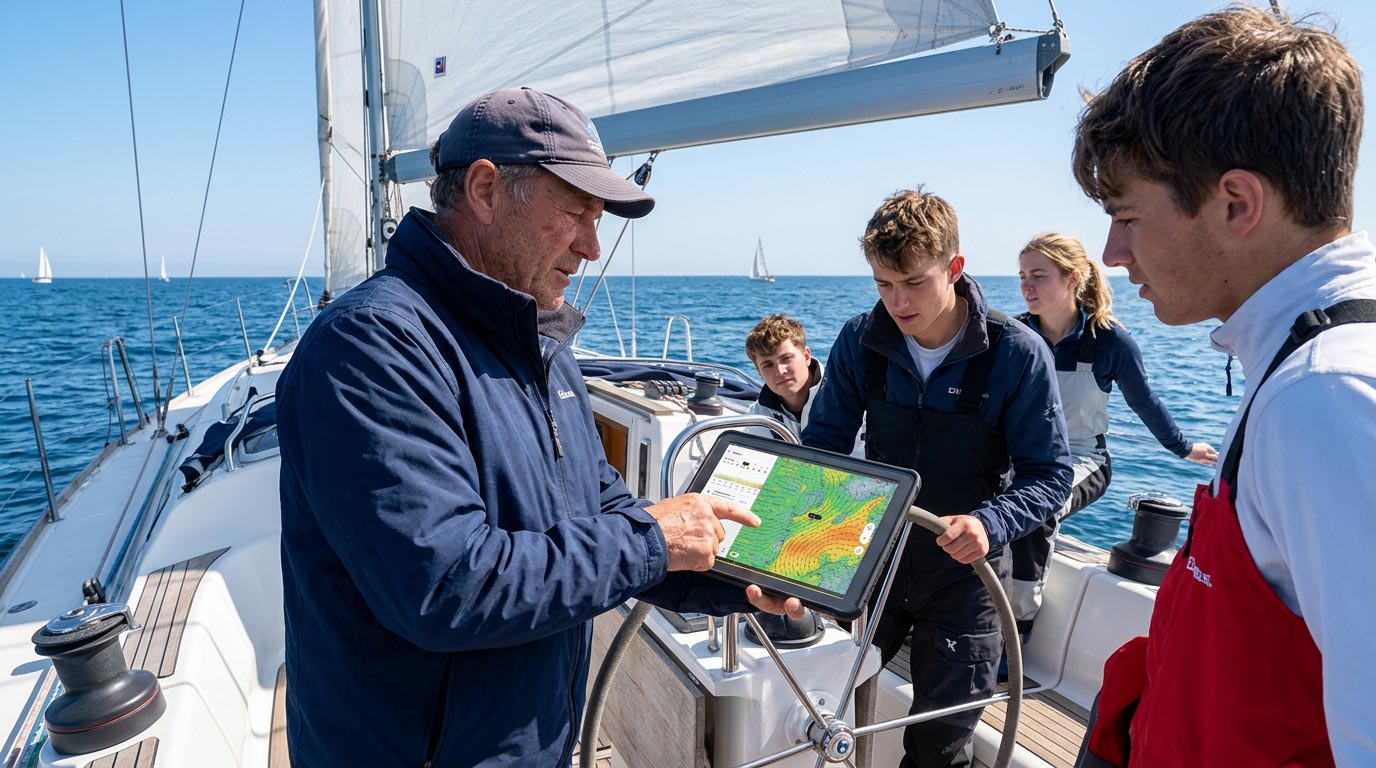
You check the forecast again. The latest information suggests that conditions may deteriorate sooner than originally anticipated. You cannot be certain how quickly the situation will develop, or exactly what conditions you will encounter along the remaining route.
Your destination is still reachable.
But the margin for error is becoming smaller.
You have several options. You could continue towards the planned destination, alter your route, or consider a suitable alternative if one is available. Each option has different implications for the crew, the boat, the remaining passage and the conditions you may encounter.
Then the questions begin.
One crew member asks whether you are still on schedule.
Another points out that the other boats in the flotilla appear to be continuing.
Someone else says, “We came here to sail. Isn’t this what we are supposed to be learning?”
Nobody is panicking. Nobody is behaving irresponsibly. They are simply expressing different expectations of the day.
You are the skipper.
The decision is yours.
Do you continue, change your plan, or stop and reassess before committing to the next leg?
There is no additional information coming to rescue you from the decision. You must decide what information you need, how to obtain it and what you will do while uncertainty remains.
Seamanship is not tested when everything goes according to plan. It is tested when the plan stops making sense.
The following is a fictional training scenario designed to explore decision-making, risk assessment and leadership at sea.
Imagine that you are responsible for this boat and everyone on board.
Do not look for the answer you think an experienced skipper would give. Think about what you would actually do, based on the information available to you.
Is the problem the stronger wind itself, the timing of the change, the crew’s condition, the remaining route, or the combination of these factors?
What would you need to establish before deciding whether to continue?
What would you check before committing to the next leg?
Consider the latest forecast, observed conditions, the boat’s position, possible shelter, alternative destinations, crew experience and condition, and the time required to reach a safe harbour.
Which of these factors could change your decision most significantly?
A destination may be reachable without the passage being a sensible choice.
How would you distinguish between what the boat can physically do and what is reasonable given the conditions, the crew and the available alternatives?
Does the behaviour of the rest of the flotilla provide useful information, or could it create pressure to follow a decision that is not appropriate for your boat?
What if the lead boat has more experienced crew, a different position, different equipment or different information?
At what point would you decide that continuing is no longer acceptable?
Would you establish a limit before departure, reassess continuously, or use a combination of both?
What observable signs would tell you that the available safety margin is disappearing?
Suppose everyone says they are comfortable and willing to proceed.
Does that settle the question?
How would you distinguish genuine confidence from overconfidence, social pressure or a reluctance to disappoint the group?
And if you decide to change the plan, how would you explain the decision without undermining the crew’s confidence?
Imagine that you initially decide to continue.
What new information would make you reverse that decision?
Now consider the opposite: you initially decide to divert, but conditions appear to improve. What would you need to know before reconsidering?
A good decision-making process must allow new evidence to change the plan.
Imagine that you continue and arrive safely at your destination.
Does that prove your decision was correct?
Now imagine that you divert to a sheltered harbour, the weather subsequently improves, and you realise that you could probably have completed the original passage.
Does that prove your decision was wrong?
Consider both situations carefully.
The outcome is visible. The quality of the decision must be judged using what was reasonably known, what could have been anticipated, the alternatives available and the risks accepted at the time.
A favourable outcome does not automatically validate a risky decision. An unfavourable outcome does not, by itself, prove that a carefully considered decision was unreasonable.
This does not mean that every decision is equally good. It means that we must examine the reasoning, the evidence and the process — not just the ending.
Write down your answers before discussing the scenario with anyone else.
What would you do first?
Would you continue, alter the route or choose an alternative?
What information would you need before committing to that choice?
What is the biggest risk associated with your decision?
What would make you change your mind?
Be prepared to explain not only what you would do, but why.
Another student may reach a different conclusion. Do not dismiss their answer simply because it differs from yours. Ask which assumptions, information or priorities led them to that conclusion.
The purpose is not to win an argument.
It is to discover how you think when the answer is not obvious.
A passage plan is not a promise that the day will unfold as expected.
A forecast is not a guarantee. Experience is not immunity from error. Confidence is not evidence that a decision is sound.
The skipper’s responsibility is not to defend the original plan at all costs. It is to keep reassessing the situation, recognise when the assumptions behind a decision have changed, and act while meaningful options remain available.
Sometimes the best decision is to continue.
Sometimes it is to alter course.
Sometimes it is to abandon the destination altogether.
The important question is not which of these decisions makes a skipper look most confident.
It is which decision can be justified by the conditions, the information available, the capabilities of the boat, the condition of the crew and the risks that remain.
Because seamanship is not about proving that you can complete the plan. It is about knowing when the plan must change.
An educational case study in seamanship, decision-making and risk awareness.