This post is also available in:
 Ελληνικα


This post is also available in:
Ελληνικα
According to the survivor’s account reported at the time, smoke and flames came from the engine area.
The smoke became so dense that access to the VHF and the main liferaft was blocked.
The skipper attempted to reach the fire but could not safely continue.
This distinction is important.
The available evidence does not support the simplified idea that Gold Fin was abandoned because of nothing more than a mistaken perception of smoke.
There was a serious fire emergency.
The vessel was ultimately reported as lost and sank while burning.
This was therefore not a case of a crew simply imagining a fire.
But it was still a case in which the quality and sequence of emergency decisions mattered enormously.
Because the next problem was the survival craft.
There are emergencies at sea that begin with a mechanical failure.
Others begin with weather.
Some begin with fire.
But sometimes, the most dangerous part of an emergency begins after the first problem appears.
It begins with a decision.
A decision made under pressure.
A decision made with incomplete information.
A decision made while people are frightened, the boat is moving violently, and everyone is looking at the skipper for an answer.
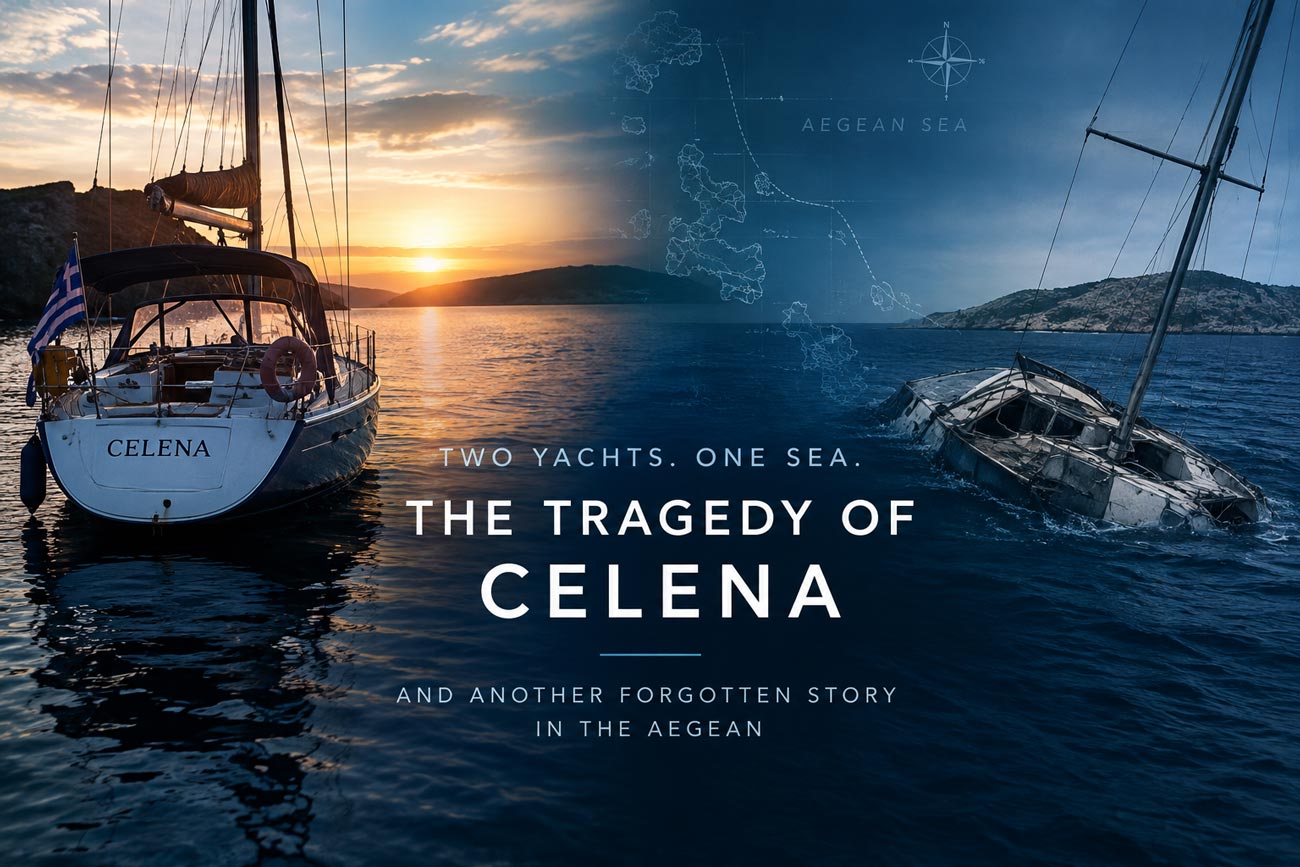
Two Aegean cases — Gold Fin in 1997 and a later case circulated as Celena, reportedly in 2003 — offer a powerful way to examine this problem.
They are not the same incident.
They should not be merged into one historical event.
The Gold Fin tragedy is extensively documented by contemporary Greek reporting and later international coverage. The Celena account, by contrast, remains much less securely documented in the sources currently available.
Yet the two stories are often discussed together because of one striking common denominator:
the moment when a crew has to decide whether the vessel is still the safest place to be.
That is where this case file begins.
The yacht carried a proper liferaft.
But the fire and smoke prevented access to it.
Instead, the crew launched a small inflatable dinghy — a tender designed for moving people between the yacht and shore, not for transporting eight people through an Aegean storm.
Eight people entered it.
The dinghy sat extremely low in the water.
The sea was rough.
There was no engine available.
There was no drinking water.
There was no food.
There were no flares or flashlights.
The crew had almost none of the equipment that would normally transform a small craft into a survival platform.
The tender was not a liferaft.
And the sea made the difference brutally clear.
One person survived.
Vagia Zisi spent approximately 15 hours in the water before reaching the small rocky island of Kavalouro.
From there, after many more hours, she was eventually spotted and rescued by a fisherman.
The others remained with the overturned inflatable.
Their bodies were found later during the search operation.
The tragedy was complete.
Eight people had left a 43-foot sailing yacht.
Their survival now depended on a six-foot inflatable tender in heavy weather.
The difference between those two environments was enormous.
It would be easy to reduce Gold Fin to:
“Never sail in bad weather.”
That would be too simple.
It would also be easy to say:
“Always stay on the yacht.”
That would be equally dangerous.
There are situations in which abandoning a vessel is absolutely necessary.
The real lesson is more difficult:
The decision to abandon a vessel must be based on the actual survivability of the alternatives.
If the yacht is burning uncontrollably, the water may become the lesser danger.
But if the survival craft is inadequate for the conditions, leaving the vessel may create a second emergency that is even harder to survive.
That is the decision space a skipper must understand.
The second case is different.
A maritime story circulated in sailing-education contexts describes a yacht referred to as Celena, reportedly involved in an Aegean tragedy around 2003.
The account describes:
approximately nine people aboard;
two families;
children among the passengers;
severe northerly weather;
an engine overheating;
thick smoke appearing inside the yacht;
the crew interpreting the smoke as a fire;
abandonment of the yacht;
the use of a small tender rather than a proper liferaft;
the tender overturning in heavy seas;
eight fatalities and one survivor.
The account also contains a particularly striking claim:
that the yacht was later found still afloat and that the smoke had resulted from overheating rather than a sustained fire.
That claim is precisely why the case deserves caution.
Despite extensive searching, I have not located sufficiently reliable primary or independent contemporary documentation that allows all of those details to be presented as established historical fact.
Therefore, in this case file, Celena is treated as a reported educational case, not as an independently verified reconstruction.
That distinction matters.
Because good seamanship begins with something very simple:
knowing what you know.
And knowing what you do not.
Because the value of a case study does not always lie in proving that two incidents were identical.
Sometimes it lies in identifying a recurring decision pattern.
In both narratives, the crew faces a frightening event aboard a yacht.
In both, the perceived threat becomes severe enough to trigger abandonment.
In both, the tender becomes central to the survival story.
And in both, the difference between a vessel and a survival craft becomes critical.
The stories therefore allow us to ask a deeper question:
Smoke is information.
It tells us something is wrong.
It does not, by itself, tell us exactly what is wrong.
Smoke can come from:
fire;
electrical faults;
overheated machinery;
belts;
oil;
coolant;
exhaust problems;
insulation;
friction;
or other mechanical failures.
The dangerous cognitive leap is:
“I see smoke.”
therefore:
“The boat is about to be destroyed.”
The skipper’s responsibility is not to underestimate the first signal.
It is to interpret it correctly.
A maritime emergency has at least two dimensions.
What is actually happening?
How are the people interpreting what is happening?
The second can rapidly amplify the first.
A frightened passenger may shout:
“Fire!”
Another may start preparing to abandon ship.
Someone else may tell the children that everything is fine.
The skipper may suddenly have ten people looking for an answer.
At that point, the technical problem is no longer the only problem.
The skipper must manage:
the crew’s perception of the emergency.
That is a leadership task.
One of the most dangerous assumptions at sea is:
“If we leave the boat, we will be safer.”
Not necessarily.
Leaving the yacht means surrendering:
freeboard;
buoyancy;
shelter;
communications equipment;
navigation equipment;
visibility;
emergency equipment;
storage;
propulsion, if available;
and a large, easily identifiable target for rescuers.
A person in the water is difficult to see.
A small tender is difficult to control.
A yacht, even a damaged one, remains a much larger survival platform.
That does not mean you should remain aboard a burning vessel.
It means the decision must be based on relative survivability.
This is perhaps the clearest common lesson.
A tender is not a substitute for a liferaft.
A tender may be perfectly adequate for:
“Take four people from the yacht to the beach.”
That does not mean it is adequate for:
“Keep eight people alive in 35–40 knots of wind and a breaking sea.”
The two requirements are completely different.
A liferaft is specifically designed for survival.
A tender is not.
Gold Fin demonstrates this distinction with tragic clarity. Contemporary reporting noted that the dinghy was heavily overloaded and quickly became difficult to control in the conditions.
Under pressure, people often see only two choices:
Stay = danger.
Leave = safety.
But emergencies rarely offer such a clean binary.
There may be other options:
stop the engine;
isolate electrical systems;
reduce sail;
alter course;
move passengers away from the affected area;
fight a localized fire;
prepare the liferaft;
establish communications;
send a distress call;
prepare abandonment equipment;
request assistance;
monitor whether the situation is deteriorating or stabilising.
The skipper’s job is not simply to choose between two options.
It is to create more options.
A useful emergency framework can be built around five questions.
Separate facts from assumptions.
Is the situation getting worse, improving or remaining stable?
Engine.
Electricity.
Fire.
Sails.
Course.
Crew.
Communications.
Not the easiest.
Not the fastest.
The safest.
Every emergency decision should have a Plan B.
And ideally:
a Plan C.
The critical question is not:
“Is there a fire?”
It is:
“Has remaining aboard become more dangerous than entering the survival craft?”
That is a very different question.
A localized fire may be controllable.
A spreading fire may not be.
Smoke may be survivable.
Toxic smoke may not be.
A damaged engine may be irrelevant to the vessel’s ability to float.
A hull breach may change everything.
The skipper must continuously reassess.
And when the threshold is crossed, abandonment should not be delayed by denial.
But neither should it be triggered by fear alone.
The contemporary reporting around Gold Fin identified numerous practical failures and vulnerabilities.
Among them were problems involving access to the VHF, access to the liferaft, fire-fighting response, and the use of an inappropriate inflatable tender as the escape craft.
The lesson is not to judge people who were trapped inside a rapidly developing fire.
The lesson is to ask:
Would our emergency equipment still be accessible when the emergency occurs?
That question is much more useful.
A liferaft hidden deep inside a vessel is technically present.
But if smoke blocks access to it, its practical availability may be zero.
A VHF below deck is useful.
But if fire blocks the companionway, it may suddenly become unreachable.
Equipment does not exist simply because it is listed on an inventory.
It exists only if the crew can reach and use it when everything goes wrong.
The Celena account adds another dimension.
If the reported sequence is accurate, the critical error was not simply the presence of smoke.
It was the transformation of uncertainty into certainty:
Smoke → Fire → Abandon Ship.
That chain can happen in seconds.
And it is precisely why emergency training should not only teach procedures.
It should teach decision-making under uncertainty.
Most crews know the words:
Fire.
Man overboard.
Abandon ship.
But knowing the words is not the same as knowing what happens next.
A skipper should be able to ask the crew:
“If you smell smoke, what is your first action?”
“Who stops the engine?”
“Who checks the source?”
“Who takes the extinguisher?”
“Who prepares the liferaft?”
“Who calls for help?”
“Who keeps the passengers calm?”
“Who decides when we actually abandon?”
Those answers should exist before the emergency.
Because once the smoke appears, there may not be time to invent them.
This is ultimately not a story about fire.
It is a story about human factors.
About perception.
About stress.
About authority.
About communication.
About incomplete information.
About how quickly a crew can move from:
“Something is wrong.”
to:
“We are lost.”
The skipper’s greatest responsibility in an emergency may therefore not be controlling the boat.
It may be controlling the decision-making environment around the boat.
Time is one of the most valuable resources at sea.
If you can safely buy another minute, you may gain:
better visibility;
more information;
a controlled fire response;
a Mayday transmission;
a better course;
a prepared liferaft;
a nearby vessel;
a change in wind or sea state;
a clearer understanding of the problem.
Panic spends time.
Good seamanship buys it.
Gold Fin gives us a documented tragedy.
Celena gives us a reported educational scenario whose historical details still require independent confirmation.
We should not turn them into one story.
But together they expose a powerful seamanship principle:
The first problem is not always the final danger.
A mechanical failure can create smoke.
Smoke can create fear.
Fear can create a decision.
A decision can create abandonment.
And abandonment can place people in an environment far more hostile than the one they were trying to escape.
That is the chain a skipper must learn to interrupt.
Imagine the situation.
Night.
Heavy weather.
Passengers aboard.
Children aboard.
Smoke coming from below.
Someone is shouting:
“Fire!”
What do you do?
Do you immediately abandon the vessel?
Or do you first determine:
where the smoke is coming from;
whether there is visible flame;
whether the engine can be stopped;
whether electrical power can be isolated;
whether the fire can be contained;
whether the crew can remain safely on deck;
whether communications remain available;
whether the liferaft can be accessed;
and whether the yacht is still the safest place to be?
There is no universal answer.
That is precisely the point.
The skipper must make the answer.
The sea does not always give you enough information.
But it gives you clues.
The skipper’s job is to collect those clues before fear turns them into a story.
Because the difference between:
“Something is wrong.”
and
“We have to abandon ship.”
may be only a few seconds.
Those seconds are where seamanship lives.
And sometimes, the most important decision on board is not how to escape the emergency.
It is deciding whether you actually need to escape the vessel at all.
Two stories.
Different levels of evidence.
One enduring seamanship lesson.
Do not confuse fear with information.
Do not confuse a tender with a liferaft.
And never make abandonment the automatic answer to an emergency.
The sea always gives the lesson.
The question is whether we are willing to learn it.