Why Most Boating Emergencies Start Long Before the Emergency
Lessons from the Helm
I have never seen a boating emergency that truly started when things went wrong.
It always starts earlier.
Sometimes hours earlier. Sometimes days.
And almost always quietly—through decisions that didn’t feel important at the time.
After more than three decades at sea in recreational boating, diving operations, and skipper training under ISSA-based instruction, one truth keeps repeating itself:
The sea rarely creates emergencies. People create the conditions for them.
The Illusion of “Sudden” Emergencies
To most people, emergencies appear sudden:
- engine failure
- weather change
- loss of navigation
- man overboard
- collision risk
But from a skipper’s perspective, these are usually not the beginning.
They are the final expression of a chain reaction.
A chain that started long before the boat left the dock.
Case Study 1: “We’ll Be Fine With That Forecast”
A crew plans a short coastal trip.
The forecast shows moderate winds.
One app says 12–15 knots. Another shows gusts up to 22 knots later in the afternoon.
The decision is made quickly:
“It looks fine. We’ve done worse.”
Departure is delayed. The route is shortened. No further briefing is done.
Two hours later, conditions change faster than expected.
Not dangerous for an experienced, prepared crew—but stressful for one that didn’t plan alternatives.
The real issue is not the weather.
It is the lack of decision layers before departure.
A better skipper would have asked:
- What if the forecast is wrong by 30%?
- What is our exit point?
- Do we have a time limit for return?
This is where emergencies are prevented—not at sea, but before departure.
The Real Beginning of a Boating Emergency
Most boating emergencies begin with small assumptions:
- “It will be fine.”
- “We’ve done this before.”
- “The GPS will guide us.”
- “We don’t need to check again.”
Individually harmless.
Collectively dangerous.
Because at sea, conditions always change faster than expectations.
Case Study 2: The Fuel That Was “Enough”
A charter boat departs with fuel “visually checked.”
No calculation of consumption under load.
No consideration of return route alternatives.
Halfway through the trip, wind increases.
Engine load increases.
Fuel consumption rises.
Nothing dramatic yet—but margins shrink silently.
At this point, stress begins to affect decisions.
Speed is reduced.
Route is altered.
Stops become necessary that were never planned.
The emergency is not engine failure.
It is planning without verification.
A trained skipper (ISSA mindset) would never rely on visual estimation alone.
They calculate, confirm, and always include reserve margins.
Experience Is Not Time — It Is Exposure
One of the most misunderstood ideas in boating is this:
Time at sea does not automatically equal competence.
Experience is built through:
- real conditions
- repeated decision-making
- exposure to uncertainty
- supervised mistakes
- reflection after each trip
That is why structured learning, such as ISSA-based training, emphasizes progression through real-world conditions—not just theory.
Advice to Every New Skipper
If there is one principle worth carrying into every voyage:
Write miles in real conditions—even under supervision.
Learn from wind, waves, and decisions that cannot be simulated.
Study continuously, attend training, and stay close to the sea.
Do not operate a boat—understand it.
Confidence without exposure is fragile.
Confidence built through real conditions is stable.
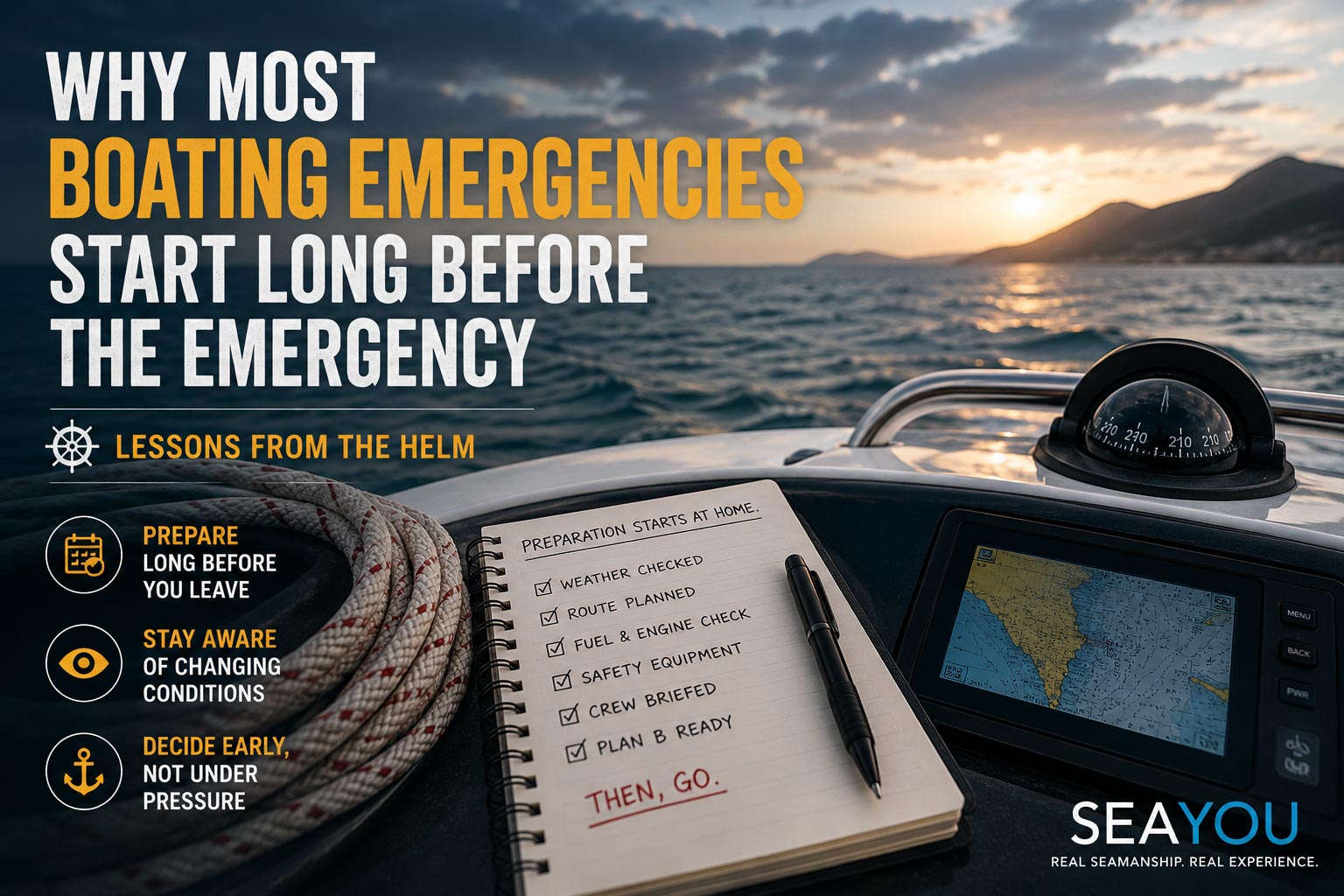
Preparation Starts at Home
Preparation starts at home.
Not at the marina.
Not at the briefing.
At home.
Before you even think about leaving.
Proper seamanship begins with:
- checking multiple weather sources
- understanding trend changes, not just snapshots
- reviewing route alternatives
- confirming equipment readiness
- mentally rehearsing “what if” scenarios
By the time the lines are released, decisions should already be made.
Case Study 3: The Overconfident Charter Crew
In charter environments, a recurring pattern appears:
A group with previous boating experience takes command of a vessel.
There is confidence—but not structured decision awareness.
The common issues are:
- incomplete briefings
- assumptions about equipment
- delayed responses to early warning signs
- over-reliance on electronics
- group decision confusion
The root cause is not lack of skill.
It is overestimation of capability relative to conditions.
This is where most operational incidents begin.
Not with the sea.
With perception.
The Skipper Decision Framework (Simple but Critical)
Experienced skippers don’t think in single decisions.
They think in layers:
1. Before departure
- What could realistically go wrong today?
2. During navigation
- What is changing that I didn’t expect?
3. Early intervention
- What is the earliest point I can still prevent escalation?
This mindset is what separates reactive boating from controlled seamanship.
Why Emergencies Rarely Feel Like Emergencies at First
Almost every serious situation begins quietly:
- a small deviation
- a minor delay
- a skipped check
- a “we’ll fix it later” decision
The danger is not the first sign.
It is the normalization of the sign.
Once abnormal becomes acceptable, escalation becomes inevitable.
Case Study 4: The Silent Navigation Drift
A vessel is following a planned route.
GPS is active.
Crew is relaxed.
No active cross-checking is performed.
A small drift begins due to current.
Nothing alarming.
But over time:
- waypoint accuracy decreases
- estimated arrival changes
- fuel consumption shifts
- timing becomes compressed
Eventually, decisions must be made under pressure.
Speed increases.
Focus narrows.
Stress rises.
The emergency was never navigation failure.
It was loss of situational awareness over time.
What Experienced Skippers Do Differently
Experienced skippers rarely appear “busy.”
But internally, they are constantly:
- validating assumptions
- scanning for changes
- updating mental models
- preparing exit options
- staying ahead of the situation
This is not instinct.
It is trained awareness.
The Core Truth of Seamanship
Boating does not reward reaction speed.
It rewards early decision quality.
And the earlier a decision is made correctly, the less likely an emergency becomes.
Final Thought
Most boating emergencies do not begin with storms or failures.
They begin with small, unnoticed compromises in preparation and judgment.
And the sea does not need to create danger.
It only needs to meet unpreparedness.
Continue Building Your Seamanship Knowledge
You may also find these useful:
About This Perspective
This article reflects practical experience from more than 30 years at sea in recreational boating, diving operations, and skipper training based on ISSA principles.
The aim is simple:
to help boaters make better decisions before they become difficult ones.